
by admin
Share
by admin
Share
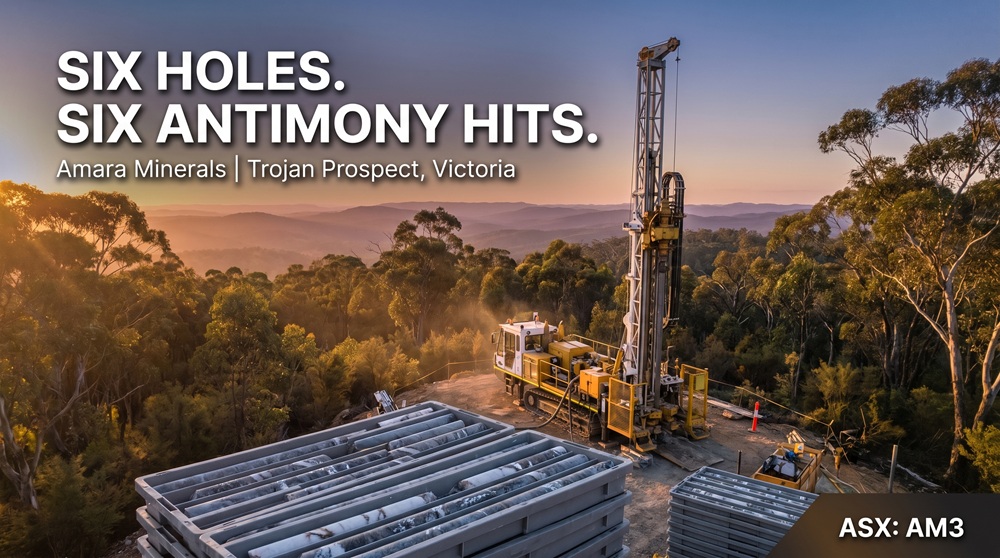
Amara Minerals has now drilled six holes into the Trojan Prospect at its Lauriston Gold and Antimony Project in central Victoria. Every hole has intersected antimony mineralisation.
The numbers
The company reported assays from the deepest hole drilled at Trojan to date:
- AY2610: 6.5m @ 0.86% Sb and 0.59 g/t Au from 142.6m (including 0.8m at 3.13% Sb and 1.59 g/t Au, and 1.0m at 2.01% Sb and 0.95 g/t Au)
- AY2609: 1.3m @ 0.38% Sb and 5.59 g/t Au from 122.7m (including a stand-out 0.5m at 10.4 g/t Au and 0.84% Sb)
- AY2606: 0.8m @ 2.08% Sb and 0.51 g/t Au from 109.8m
AY2610 matters more than the others. It’s the deepest hole drilled at Trojan, it’s the widest antimony intercept, and the antimony grade is among the strongest reported. In an early exploration play, the combination of depth, width and grade all moving in the same direction is a positive indicator.
Assays from AY2611 and AY2612 are still pending.
Lauriston’s Geological Address
Lauriston sits in central Victoria, next door to three of the most-watched gold-antimony deposits in the world.
Fosterville (Agnico Eagle) is the benchmark. The Swan Zone discovery in 2016 turned it into one of the highest-grade gold mines on the planet, peaking above 500,000 oz/year at 23.7 g/t. Reserves still grade north of 6 g/t. Agnico is spending roughly US$34 million on Fosterville exploration in 2026, much of it hunting for Swan-style structures in parallel faults nearby.
Costerfield (Alkane Resources, post its 2025 merger with Mandalay) is Australia’s only operating antimony mine. Since 2009 it has produced 577,000 ounces of gold and 65,000 tonnes of antimony at 9.1 g/t Au and 3.3% Sb. It’s about an hour’s drive from Lauriston.
Sunday Creek (Southern Cross Gold Consolidated) is the new entrant. SDDSC196 returned 559m at 2.5 g/t AuEq earlier this year. Pybar has just been awarded the exploration decline contract, with rig count set to expand from 11 to 24.
All three are epizonal orogenic gold-antimony systems, gold and stibnite co-precipitating in shear-hosted vein arrays at shallow crustal depths. The textures Amara is reporting at Trojan, gold-bearing quartz veins overprinted by stibnite-rich fault pug zones and quartz breccia, match that template exactly.
The geology stacks up
Drilling at Trojan has now defined a consistent west-dipping shear, geometrically similar to the Comet Shear 3 km to the south. Antimony is concentrated in discrete shoots within fault pug zones. The projected strike correlates with a 2.2 km soil anomaly running north to the Countess prospect.
Only about 250 m of that 2.2 km trend has been drill-tested. For context, Costerfield’s Central Corridor, which has sustained 15 years of continuous mining, is around 6 km long. Trojan-Countess alone, if it delivers, gives Amara roughly a third of that footprint to drill out. The broader Comet-Trojan corridor extends to 4.5 km.
The fact that AY2610 is improving at depth matters. Most exploration plays start strong at surface and grade off downward. Trojan is doing the opposite.
Vertical zonation. Epizonal systems typically show antimony dominant in the upper portions and gold dominant at depth, because antimony is more volatile and travels higher in the system. Trojan is hitting broader, stronger antimony deeper, not shallower. That means either Amara has drilled into a particularly antimony-rich shoot or the system has serious vertical extent and they haven’t seen the gold-dominant lower zone yet. Fosterville’s Swan Zone sits more than 1,000 m below surface. AY2610 bottoms out at around 200 m.
Photon assay. Samples are going for photon assaying to test for coarse gold. Victorian epizonal systems are notorious for nuggety gold distributions that conventional 30 g fire assay charges can underestimate. The photon results could re-rate existing intercepts upward, with the project’s grade profile shifting.
Antimony: the macro backdrop
Antimony prices peaked above US$59,000 per tonne in July 2025, roughly four times pre-2024 levels. Even after China partially eased export controls in November 2025, Q1 2026 prices have settled in a structurally elevated USD 32–45/kg band, with North American prices at USD 42–55/kg. The US Department of Defense has put more than US$59 million into Perpetua’s Stibnite project in Idaho specifically to rebuild domestic supply.
Australia produces antimony from one mine: Costerfield. Victoria hosts the third-largest antimony deposits in the Western world. The Victorian Government has opened the $1 million Advancing Antimony Grants program to support downstream processing; Amara has stated that it will apply.
Other things worth knowing
Yankee sits immediately north of Trojan and targets a completely different style, Bendigo saddle reefs. Drilling so far has only intersected the “legs” of these structures, not the high-grade “saddles”, because the approved drill collar positions weren’t geometrically optimal. That’s an untested target type within the same tenement.
Comet drilling has restarted to follow up the high-grade CND03 intercept (0.89m at 2.24% Sb and 1.26 g/t Au, including 0.1m at 10.3% Sb and 3.22 g/t Au).
Apollo is next. The rig is scheduled to move to Amara’s Apollo Project after the first-phase Lauriston program wraps, focusing on infill drilling for resource estimation. Apollo carries bulk-tonnage gold potential plus stibnite mineralisation at the Heyfield Reef (historical 3m at 5.2 g/t Au and 3.4% Sb).
Tenement scale. Lauriston is 28,700 hectares. The current drilling is only scratching the surface.
Summary
What Amara has delivered is the early-stage trifecta good juniors need:
- Consistency: six holes, six antimony hits.
- Scale: a 2.2 km soil anomaly with only 250 m drill-tested.
- Depth potential: the deepest hole is one of the best.