
by admin
Share
by admin
Share
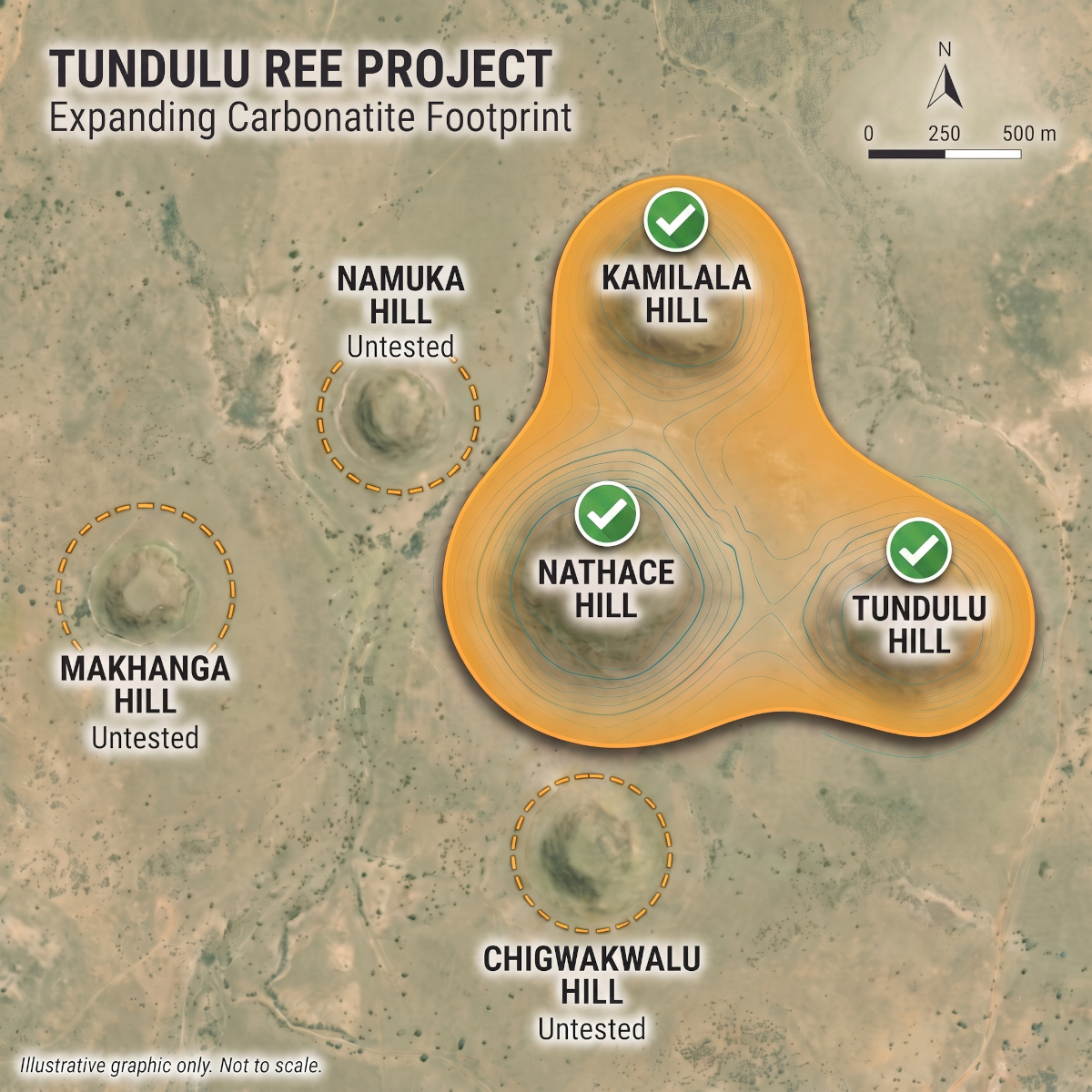
AuKing Mining Limited (ASX: AKN) has replicated previous success with the latest round of step-out drilling confirming carbonatite intersections in every single drill hole across Kamilala Hill and Tundulu Hill, some 800 metres east of the historically drilled Nathace Hill.
The carbonatite footprint continues to grow well beyond initial expectations, and mounting evidence that Tundulu is shaping up as a genuinely district-scale rare earths opportunity.
The hit rate
Exploration success is rarely this consistent. Of the first 27 reverse circulation (RC) drillholes completed, carbonatite has been logged in 26, an exceptional hit rate of 96%. More than 3,850 metres of RC drilling has now been completed as part of the proposed upsized 15,000 metre combined RC and diamond drilling program.
The numbers get better. Cumulative logged carbonatite now exceeds 2,000 metres across the program, with nine drillholes each containing more than 100 metres of logged carbonatite. That is the kind of continuity and scale that should get geologists, and investors, paying close attention.
The Geological Model Is Working
What makes this round of results particularly significant is where the carbonatite is turning up. These step-out holes were deliberately positioned well away from the primary Nathace Hill target area, designed specifically to test targets generated from AuKing’s recent airborne magnetic survey.
Every one of those holes intersected carbonatite lithologies. Multiple carbonatite intrusions were hit on both the western and eastern sectors of Tundulu Hill, reinforcing confidence in the magnetic survey interpretation and the Company’s overall geological model.
Drilling has now delineated extensive carbonatite geology across Nathace Hill, Kamilala Hill and Tundulu Hill. That is three of the six interpreted carbonatite complexes within the broader Tundulu Project area confirmed as hosting large-scale carbonatite, and the remaining three complexes at Makhanga Hill, Namuka Hill and Chigwakwalu Hill are yet to be drill-tested. The upside potential remains wide open.
Mineralised Carbonatite Potential
Intersecting carbonatite is one thing. The obvious question is whether it carries rare earths, and here the historical record at Tundulu is compelling.
Shallow drilling by the Japanese International Cooperation Agency (JICA) in the late 1980s returned a standout intercept of 41m @ 3.7% total rare earth oxides (TREO) from just 8 metres depth. Subsequent drilling by Mota-Engil and Optichem in 2014 and 2015, which was originally targeting phosphate, delivered hits including 30m @ 4.03% TREO from surface.
Tellingly, 24 historical drill holes across the project ended in mineralisation, including eight that finished in grades above 2% TREO, among them hole TU073 with 10m @ 3.13% TREO from 113 metres to end of hole. In other words, historical drillers repeatedly ran out of hole before they ran out of rare earths.
More recent work by previous owner Tusker Minerals (formerly DY6 Metals) added to the picture. Its reinterpretation of the combined historical dataset identified several continuous zones of high-grade mineralisation, hosted in REE-rich carbonatite and apatite, and initial assessments indicated the mineralisation is enriched in valuable middle and heavy rare earths with low levels of uranium and thorium, an attractive profile for downstream processing.
Encouragingly, there are early field-level signals too. In a video field update posted to AuKing’s official X account, Senior Geologist Derek Halford reported that portable XRF readings taken during drilling had detected rare earth elements in quantities of interest at Kamilala Hill and Tundulu Hill.
Portable XRF is an indicative field screening tool rather than a substitute for laboratory assays, and no assay data has yet been reported, but it is a promising pointer that the newly confirmed carbonatites may carry mineralisation, not just favourable host rock.
Still, the important caveat stands: nearly all of the historical high-grade drilling was concentrated at Nathace Hill.
What AuKing’s current program has done is confirm the same host rock, carbonatite, extending across Kamilala Hill and Tundulu Hill as well. Whether those newly confirmed carbonatites carry comparable rare earth grades is precisely what the pending laboratory assays will answer. If they do, the implications for the scale of the mineralised system are mesmirising.
Management Confidence
AuKing’s Managing Director Paul Williams summed up the momentum, noting the exploration team’s excellent progress and highlighting that the interpreted carbonatite extends across almost all drill holes to date, not just those around Nathace Hill. In his words, Tundulu clearly has the potential to be a much larger system than was first thought, with formal conclusions to follow once assay results are in.
What Comes Next
- Assays pending. Drill samples are being prepared for laboratory analysis to determine the nature and extent of any associated rare earth mineralisation.
- Diamond drilling imminent. Drilling contractor Thompson Resources expects to mobilise the diamond rig to site in late July, with deeper diamond drilling to follow the RC program.
- More RC metres to come. A further three RC holes totalling approximately 450 metres are planned, taking the RC component to roughly 4,130 metres across 28 drillholes.
- The diamond program will combine holes drilled from surface with diamond tails extending selected RC holes, guided by geological logging, geophysical targets and assay results as they come to hand.
The Bottom Line
With a 96% carbonatite hit rate, over two kilometres of logged carbonatite, three of six complexes confirmed and three more yet to be tested, AuKing’s Tundulu Project is rapidly building a compelling case as a district-scale rare earths system in one of Africa’s emerging critical minerals jurisdictions.
Assay results and the arrival of the diamond rig loom as the next major milestones.
This piece is based on AuKing Mining Limited’s ASX announcement dated 15 July 2026. It is general information only and does not constitute financial product advice. Laboratory assay results are pending and no assay data has yet been reported. Investors should read the full ASX announcement and seek independent advice before making any investment decision.