
by admin
Share
by admin
Share
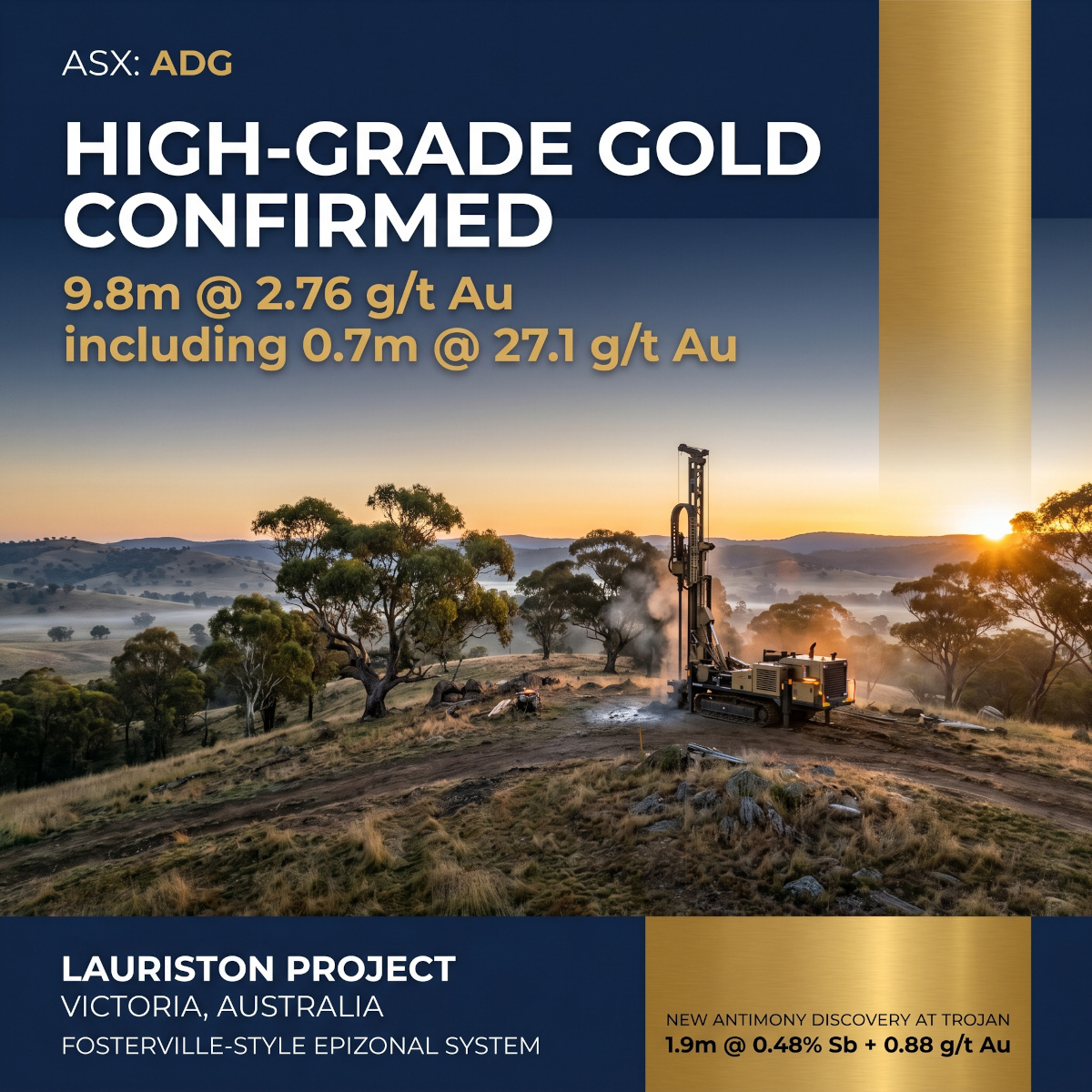
Adelong Gold has released its first batch of diamond drilling assays from the Lauriston Gold and Antimony Project.
Across the six holes drilled at the Comet prospect and the first three holes at the brand new Trojan prospect, the company has now delivered assays that validates the geological model, confirms high grade gold in the Comet Shear, and opens up a genuine antimony discovery along a structurally controlled corridor that runs for kilometres.
The Lauriston assay data contains encouraging early stage numbers, that go beyond mere bullet points.
AC2502: Standout result from the program
The standout result from the program is hole AC2502, which returned 9.8m @ 2.76 g/t Au from 90.9m down hole.
Inside that intercept sits a 0.7m hit @ 27.1 g/t Au from 100m, and a 0.6m hit @ 5.33 g/t au from 91.4 metres.
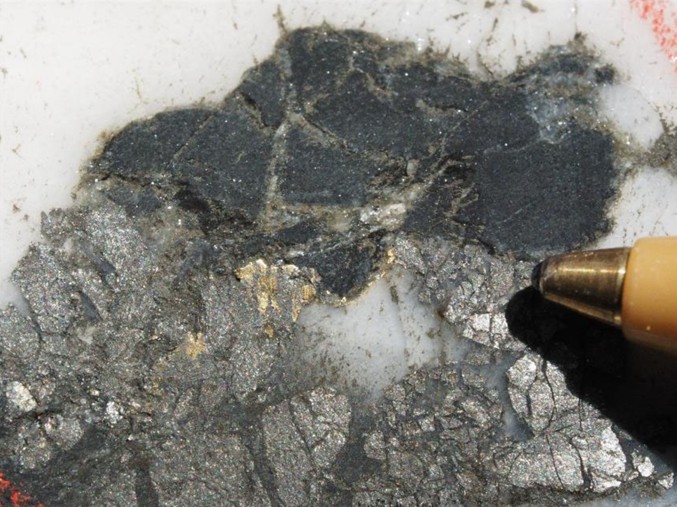
Visible gold observed in AC2502
Immediately above the main zone, the same hole delivered another 4.3m @ 1.01 g/t Au from 82.7 metres. Put those numbers together and AC2502 carries more than fourteen metres of gold mineralisation over a roughly twenty metre window, with a bonanza grade core.
Grades of this order are uncommon in first pass exploration drilling. A 27.1 g/t Au intercept sits firmly in the grade range that made the nearby Fosterville mine famous, and the sample in question also recorded arsenic above 10,000 ppm, which is the upper detection limit of the assay method.
That combination of very high gold and saturated arsenic is exactly what a geologist wants to see in an epizonal system. It indicates the hole has intersected a high tenor fluid conduit rather than a peripheral halo.
Crucially, visible gold was observed in the core of AC2502 before assays were returned. The assays have now confirmed what the eye suggested, and they have done so emphatically.
AC2504 and AC2505: Supporting Cast With Range
Hole AC2504 produced two separate intervals of interest, with 1.0m @ 3.09 grams g/t Au from 166.6m and 0.8m @ 1.84 g/t Au from 146.8 metres.
Hole AC2505 went three better. It returned 5.1m @ 0.53 grams g/t Au from 154.3m, inside which sits 0.7m @ 1.20 g/t Au, along with two additional high grade points at 1.0m @ 2.69 g/t Au from 168.3m and 0.4m @ 3.28 g/t Au from 171.6m.
AC2505 also recorded arsenic values up to 6,430 ppm across the same zone.
The importance of AC2505 is easy to miss. It tells us that gold mineralisation at Comet is not confined to a single narrow vein but can occur as broader tension vein arrays within the brittle sandstone package surrounding the shear.
For a junior with aspirations of growing tonnage, that is a valuable piece of information. It means the system has both high grade shoots and bulk tonnage potential, and it means future drilling can test for both.
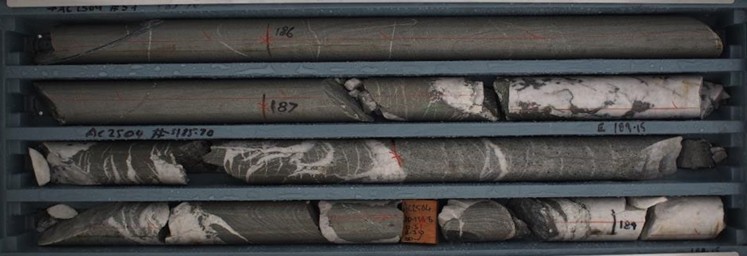
AC2504: 186 – 189m tension vein array in sandstones and grits
AC2501, AC2503 and AC2506: Every Hole Contributed
The remaining three Comet holes each returned narrower intercepts but each carried gold mineralisation in the target structure.
AC2501 returned 1.4m @ 1.24 g/t Au (including 0.8 metres at 1.83 grams per tonne gold) and a separate 3.6m interval @ 0.38 g/t Au, extending the Comet Shear approximately 80 metres down dip from previous drilling.
AC2503 picked up 1.5m @ 0.69 g/t Au from 107m, in a zone now interpreted to possibly represent a stacked shear beneath the main Comet structure.
AC2506 delivered 0.5m @ 1.65 g/t Au from 202.9m alongside strong arsenic values.
The headline here is that every single Comet hole intersected the target structure. Six from six is an unusually clean hit rate for an early stage program, and it speaks to the consistency and predictability of Adelong’s geological model.
New Trojan: The Antimony Numbers Arrive
Three kilometres north of Comet, the first three assays from the New Trojan prospect have confirmed a growing antimony footprint.
AY2605 returned 0.7m @ 1.46% Sb and 0.49 g/t Au from 96m, together with a further 0.4m @ 1.05 g/t Au just below.
AY2607 delivered 0.3m at 0.67% Sb and 3.80 g/t Au from 90.9m, a combined hit that carries real commercial resonance given the current price environment for both metals.
AY2608 returned the widest intercept of the three, at 1.9m @ 0.48% Sb and 0.88 g/t Au from 103.3m.
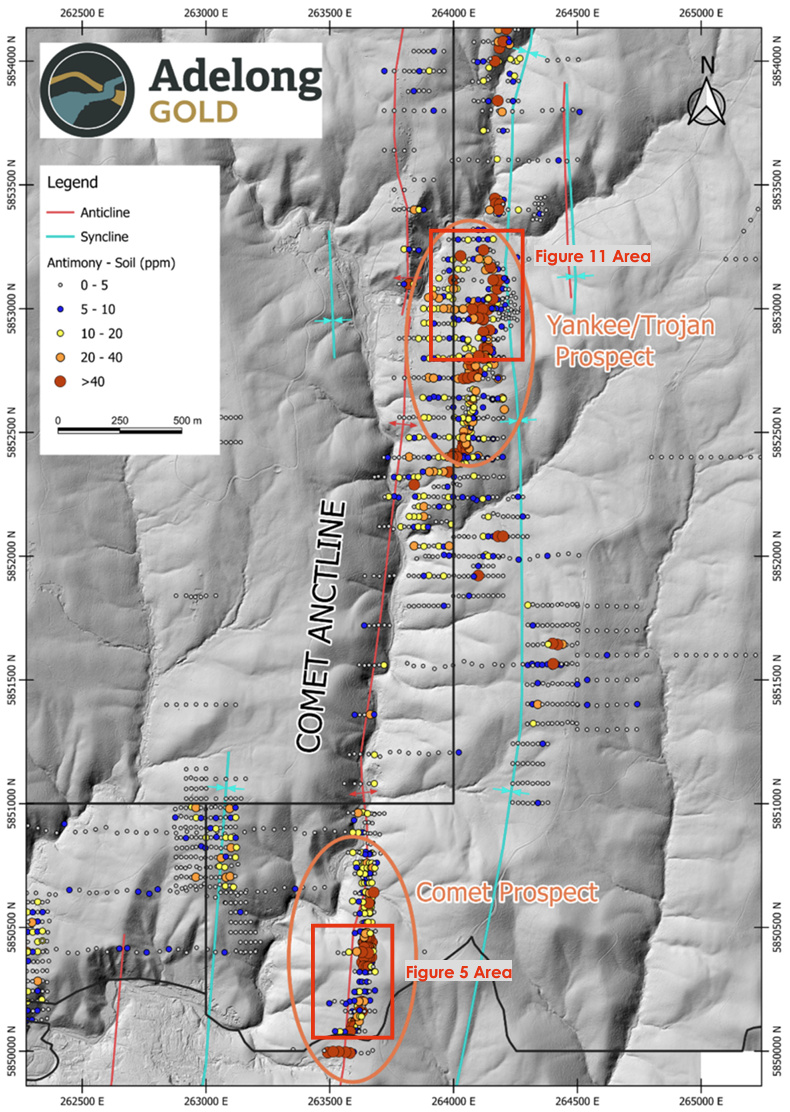
Lauriston Gold and Antimony Project – Comet and Yankee/Trojan Prospects
These grades are not incidental trace readings. Antimony at 1.46% is a commercially interesting grade in its own right, and when it sits alongside gold the economics improve further.
For a first phase drill program aimed primarily at testing a geological hypothesis, the fact that every one of the first three Trojan holes has returned significant antimony assays is an exceptional outcome.
Reading Between the Numbers
Stand back from the individual intercepts and a clearer picture emerges. The Company has now assayed gold grades ranging from sub gramme trace values in the halo zones to 27.1 g/t au in the core of AC2502, spanning the exact spectrum expected from a classic zoned epizonal system.
Arsenic values climb from the low hundreds of parts per million in peripheral sampling to off the scale readings inside the best intercepts. Antimony, previously only a soil sample signal, is now confirmed in core at grades exceeding 1%.
Importantly, coarse visible gold has already been observed, with photon assay results still to come across the full sample set. Photon assay is the preferred technique for catching nuggety gold that conventional fire assay can miss, and any upside in those results is pure optionality from here.
What The Assays Have Delivered
Taken together, the assay results released does three things for Adelong Gold:
- It proves the Comet Shear carries genuine high grade gold within a Fosterville style geochemical envelope.
- It introduces New Trojan as a legitimate gold antimony discovery on the same regional trend.
- It sets up the next phase of drilling along a 4.5 kilometre corridor with a very clear target set.
The numbers, read in full, are the quietly encouraging kind that tend to precede a re-rate rather than accompany one.