
Open at Depth: AuKing’s First Tundulu Diamond Hole Hits Carbonatite All the Way to 510m
AuKing Mining (ASX: AKN) has completed the first diamond hole at its Tundulu Rare Earths Project in southern Malawi at 510.62m, well beyond the 300m originally planned. Carbonatite was logged continuously to the end of the hole, and end-of-hole logging indicates the geology remains open at depth. The first 1,270 RC samples are now being assayed at Intertek’s Perth laboratory.
The numbers that matter
The hole that kept going
Diamond drilling at Tundulu started at 26NH032, a hole already drilled by RC to 150m. The plan was a 150m diamond tail, taking it to 300m total.
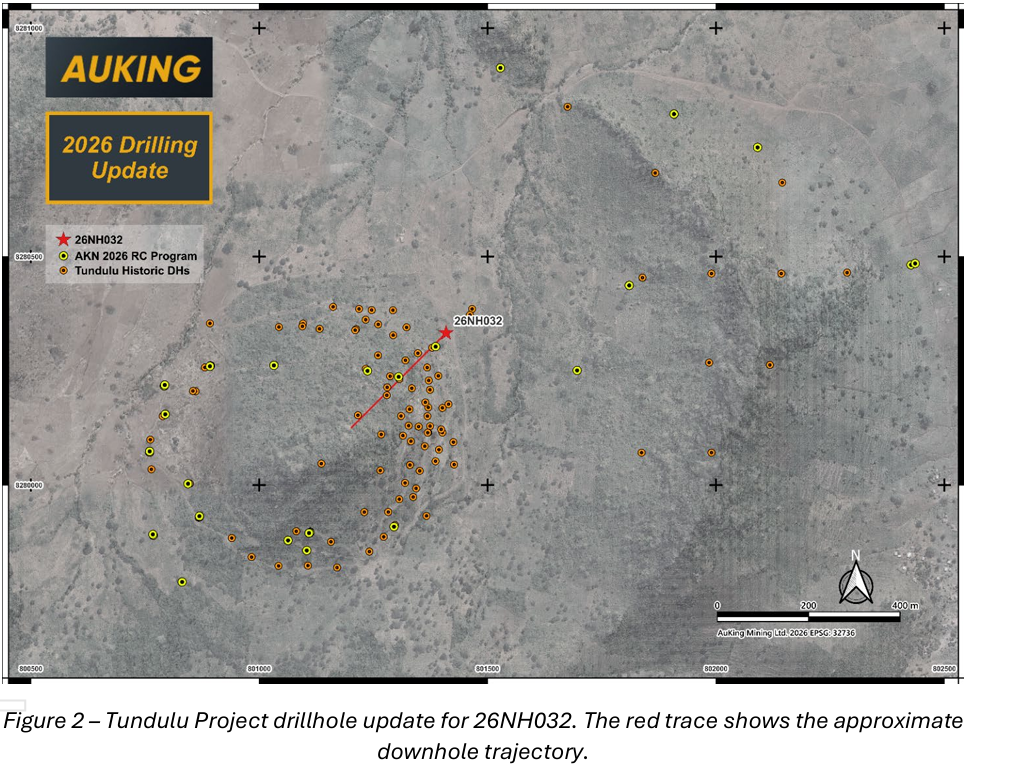
Tundulu Project drillhole update for 26NH032. The red trace shows the approximate downhole trajectory. Source: AuKing Mining Limited, ASX announcement 17 August 2026.
As drilling continued, logging identified carbonatite intrusions well past that point, and the decision was taken to extend the hole. It was eventually stopped at 510.6m, with extensive carbonatite geology logged throughout.
The important detail is how it finished. End-of-hole logging does not indicate the carbonatite has ended. Core photographed from roughly 505.2m to 510.6m shows variably altered carbonatite and carbonatite breccias continuing to the bottom of the hole. AuKing stopped because it had the data it needed at this stage of the program, not because the geology ran out. Other deeper holes are planned.
In exploration terms the system is open at depth, meaning the deposit has not been closed off and subsequent holes have room to add to the model rather than simply confirm it.
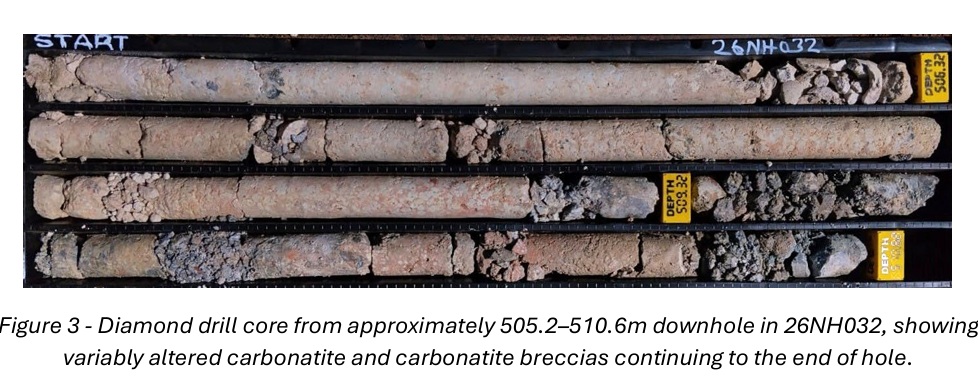
Diamond drill core from approximately 505.2 to 510.6m downhole in 26NH032, showing variably altered carbonatite and carbonatite breccias continuing to the end of hole. Source: AuKing Mining Limited, ASX announcement 17 August 2026.
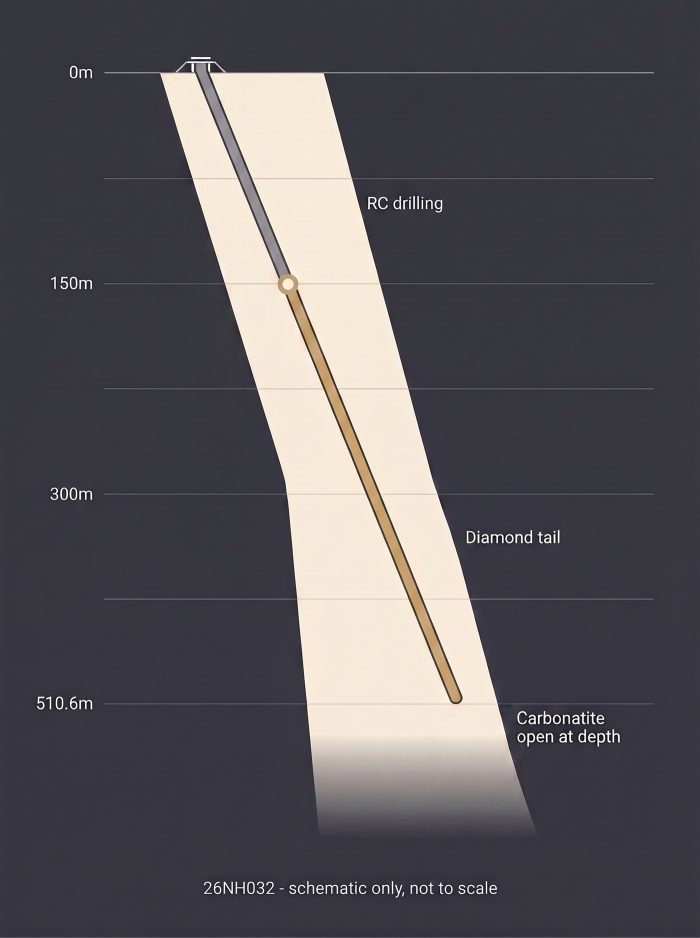
Schematic representation of drillhole 26NH032. Illustrative only, not to scale and not a company section. Colours denote drilling method, not geology. Depths per AuKing Mining Limited, ASX announcement 17 August 2026.
How the carbonatite story has built
Tundulu was drilled decades ago by parties chasing phosphate, not rare earths. JICA worked the ground in 1987, followed by Mota-Engil and Optichem in 2014 and 2015.
The intercepts they reported were shallow and strong: 41m at 3.7% TREO from 8m, 35m at 2.7% TREO from 15m, and 30m at 4.03% TREO from surface.
The detail that matters most is how those holes finished. Twenty-four historical holes ended in mineralisation, eight of them grading above 2% TREO at the point the hole was terminated. They stopped because the program’s objective had been met, not because the mineralisation had. The system was never closed off at depth, and it has sat that way for close to forty years.
Note that these are historical results reported by previous explorers. They have not been verified by AuKing through modern drilling.
AuKing’s maiden RC program wrapped up on 31 July with 4,300m drilled across 31 holes.
Geological logging confirmed carbonatite in 28 of the 31 holes, a 90% hit rate, with cumulative logged carbonatite exceeding 2,100m across the program. Seven individual holes each logged more than 100m of carbonatite.
The hits were not confined to Nathace Hill. Step-out holes designed off the airborne magnetic survey, sitting several hundred metres from the main target, came in with carbonatite as well. That was the first hard evidence for a district-scale intrusive complex rather than an isolated hill.
The RC phase established width. 26NH032 has now started to establish depth.
The Company’s wording on this is worth reading carefully. Widespread carbonatite across the surface footprint initially strengthened the interpretation of a district-scale complex. The extension of that geology to substantial depths now indicates the complex may be significantly larger than previously interpreted.
That is an upgrade to the model on both axes at once: broader across surface, and deeper than previously assumed. Both feed directly into the planned maiden Mineral Resource Estimate.
| Attribute | 26NH032 |
|---|---|
| Type | RC + DDH (diamond tail) |
| Easting | 801423.4 |
| Northing | 8280349 |
| RL | 679.3 |
| Total depth | 510.6m |
| Azimuth | 225 |
| Dip | -55 |
Grid system is WGS 84 UTM Zone 36 South. Diamond drilling is being undertaken by Thompson Drilling in Malawi using NQ-diameter core. Reported intersections are downhole lengths and true widths are not yet known.
Straight talk on the assay delays
We also share investors’ frustrations with the delays in assay reporting of the early Tundulu drilling.
Rather than glossing over it, Williams named the issue directly and set out what has been done about it: expediting export permitting, transport from Malawi to Zambia, sample preparation, and export on to the laboratory in Perth. His view is that AuKing’s logistics have moved faster than the regional norm, and that with samples now inside Intertek’s Perth facility, turnaround should be timely.
He was equally direct on the geology, noting that observations from the initially planned 300m hole compelled the drilling to continue well beyond that depth, with carbonatite confirmed throughout.
Where the samples actually are
The assay pipeline runs across three countries. Here is the current position at each stage.
Diamond core is logged, photographed and cut longitudinally, with half-core submitted for analysis and half retained in labelled trays. Sampling is planned on nominal 1m intervals, flexing between 0.5m and 1.5m to honour geological and mineralisation boundaries. Core stays under Company supervision through to AuKing’s Zomba core processing and storage facility.
Reading between the lines
Summary
Historic drilling at Tundulu was shallow and repeatedly stopped while still in mineralisation. AuKing’s RC phase then found carbonatite in 28 of 31 holes across a footprint far wider than the historically drilled ground. The first diamond hole has now carried that same geology to 510.6m and ended without closing it off.
The geological case keeps getting bigger in every direction it is tested. What it has never had is a modern grade dataset, and that is what is sitting in a laboratory in Perth right now.
Reporting notes: this article summarises AuKing Mining Limited’s ASX announcement of 17 August 2026 together with publicly reported information from earlier releases. No assay data has been reported from the current drilling program and no diamond core assay results have been reported. Visual observations and geological interpretations of drill core are based on preliminary logging and are not a substitute for laboratory analysis. Historical drilling results were reported by previous explorers and have not been verified by AuKing through modern drilling.
This content is general information and commentary only. It is not financial product advice and does not take into account your objectives, financial situation or needs. Exploration is inherently high risk. Do your own research and consider obtaining advice from a licensed financial adviser before making any investment decision.