
AuKing Mining’s second batch of assays from Tundulu, released on 21 September, delivered the project’s highest grade so far. It came from a hole pointed away from the known system.
Step through the result below. The map starts with the whole ring complex and works in to the step-out.
Imagery © Esri
1 of 7
A carbonatite ring in southern Malawi
Tundulu is a ring complex about 5 km across in the Phalombe District, and mapping and airborne magnetics pick out six separate carbonatite hills inside it.
Carbonatites are where most of the world’s rare earth supply outside China comes from. Malawi already hosts two advanced ones: Kangankunde and Songwe Hill.
2 of 7
Drilled before, but not for this
Two campaigns drilled Nathace Hill before 2026. JICA went after rare earths in 1988, but its rig averaged about 50 m. Optichem and Mota-Engil reached 221 m in 2014 and 2015, but were looking for phosphate.
Neither combined the target with the depth. That is what 2026 set out to do.
3 of 7
First assays, 14 September
The first four holes came back on the eastern side of Nathace Hill.
Grades that match the best of the historical record, from holes sited deliberately to test it.
4 of 7
Then a step-out, 400 metres west
On 21 September came five holes from the western flank, about 400 m away.
26NH011 was drilled due west, away from the known system, to test how far it extends. It was mineralised from the first metre, including 16 m @ 5.52% TREO, the highest grade reported at Tundulu so far.
5 of 7
Mineralised at both ends of 400 metres
Put the two batches together and mineralisation is now confirmed from surface at both ends of a roughly 400 m east to west section.
Three holes are mineralised from the first metre: 26NH029 in the east, 26NH011 and 26NH002 in the west. In between, 26NH014 returned several mineralised intervals at lower grade, and 26NH001 is still at the laboratory.
6 of 7
The priority target is still to report
North of the first batch, AuKing marks a large central core as its priority target.
Five 2026 holes were drilled into it from its edges, including the two deepest on the project: 26NH032, which ended in carbonatite at 510.6 m, and 26NH023 at 400 m. Only one of the five has reported.
About 2,900 samples are still at the laboratory, and more than 1,300 m of diamond core is being prepared.
7 of 7
And Nathace is one hill of six
Everything so far sits on a single complex. Carbonatite has been confirmed in three of the six, and only Nathace has been drilled in any density.
Three have never had a rig on them at all. A 1,000 m diamond hole is approved, and a maiden resource is targeted before the end of 2026.
Drill collars from AuKing Mining ASX releases of 14 and 21 September 2026, surveyed in WGS 84 UTM 36S. Historical collars are indicative. Hover a hole for its result. Independent analysis by Bullseye Analytics, not investment advice. Full interactive map at tunduluproject.com.
What AuKing reported
The release covered five reverse circulation holes on the western flank of Nathace Hill: 26NH011, 26NH002, 26NH003, 26NH008 and 26NH009. Two came with headline intervals.
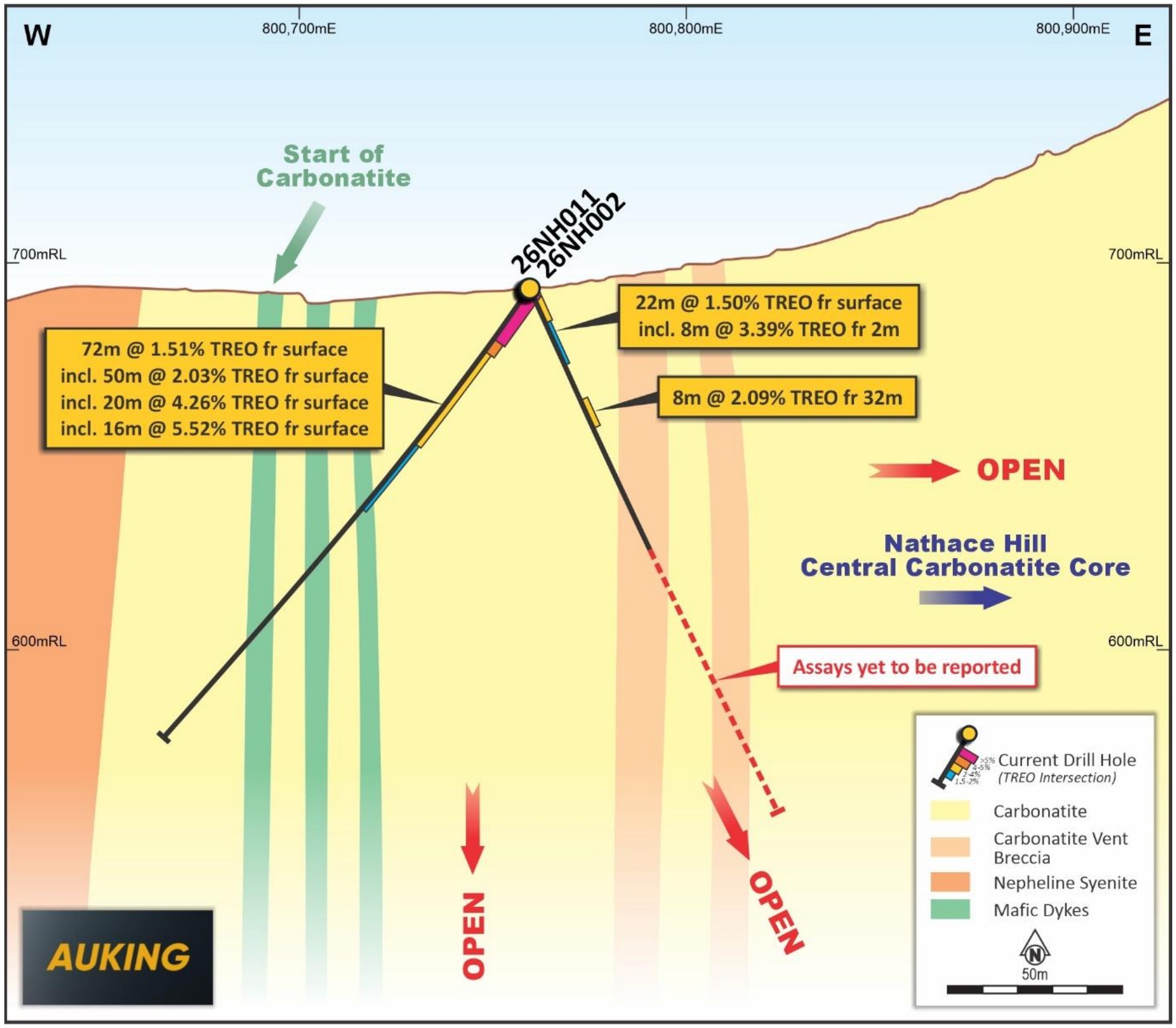
26NH011 returned 72 m @ 1.51% TREO from surface, including 50 m @ 2.03%, 20 m @ 4.26% and 16 m @ 5.52%, every one of them starting at the surface. The 5.52% interval is the highest grade AuKing has reported at Tundulu, and it sits in the release’s cross-section rather than its highlights.
26NH002, collared three metres away and drilled in the opposite direction, returned 22 m @ 1.50% TREO from surface, including 8 m @ 3.39% from 2 m and 8 m @ 2.09% from 32 m. Those assays cover the first 73 m of a 150 m hole. The rest is still at the laboratory, through a section AuKing has logged as further carbonatite.
26NH003, further north on the same flank, is reported to have intersected significant mineralisation at greater depth. Assays for 26NH008 and 26NH009 were returned in the same batch without highlighted intervals.
Why the direction matters
The first four holes, reported on 14 September, were sited to test ground that the historical drilling already pointed to. 26NH011 was designed to test how far the system extends. It was collared on the western edge of the drilled area and drilled at an azimuth of 270 degrees, due west, away from Nathace Hill and the known mineralisation.
The grades say the system is rich. The direction says it is bigger than the drilling so far has assumed: a hole that finds mineralisation while pointing away from a deposit is telling you the deposit keeps going.
A footprint that keeps growing
Put the two batches side by side and mineralisation is now confirmed from surface at both ends of a roughly 400 m east to west section. 26NH011’s westward run reaches about 800,718 mE; 26NH004, in the first batch, sits at 801,111 mE.
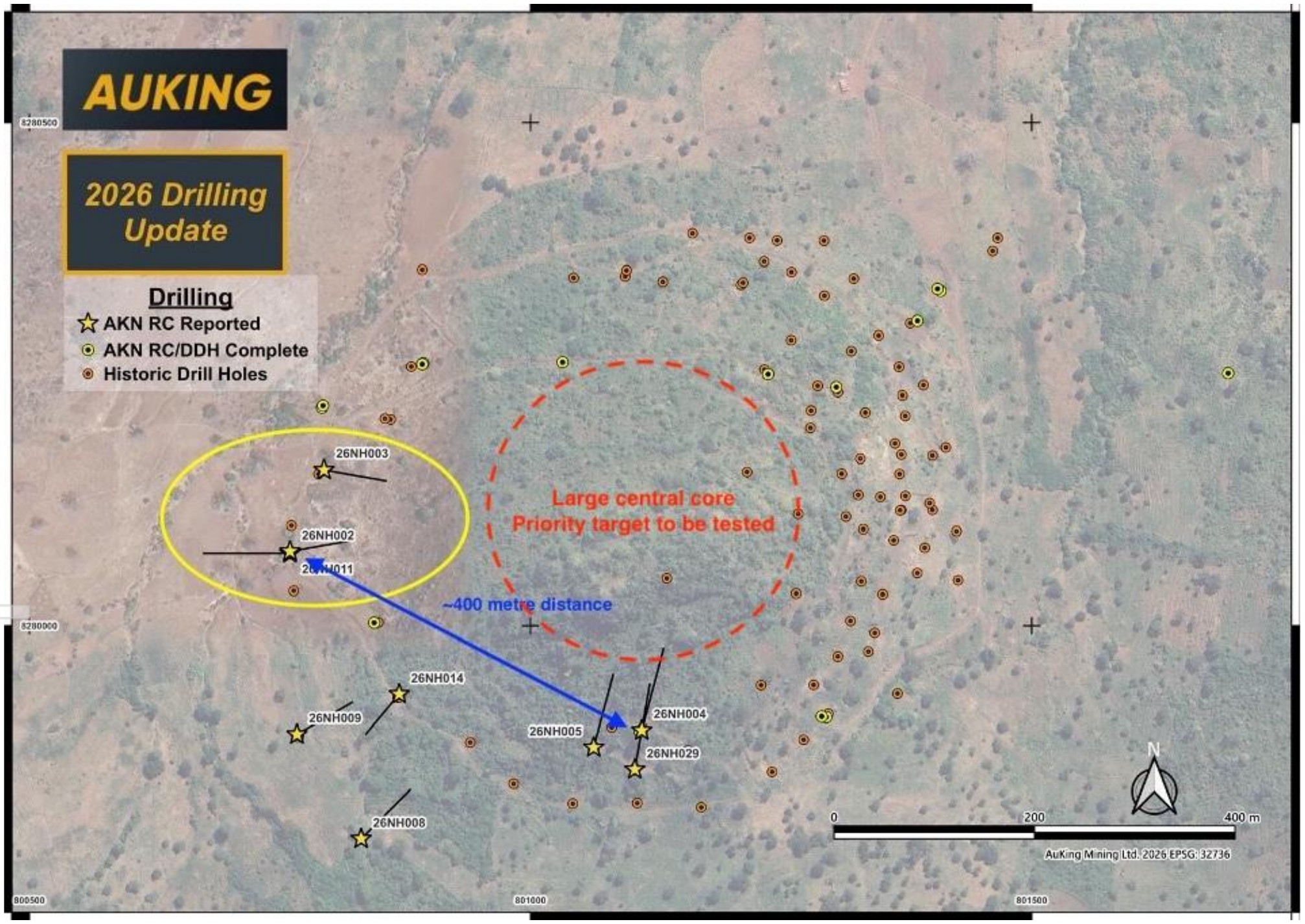
Three holes are now mineralised from the first metre: 26NH029 in the east, 26NH011 and 26NH002 in the west. Between them, 26NH014 returned several mineralised intervals at lower grade, and 26NH001, which sits almost on the line, is still at the laboratory. Near-surface grade over that distance is the geometry that decides strip ratios, and it says more about eventual economics than any single interval.
The outlook
Nine of the 31 RC holes have now reported. About 1,500 samples have been assayed, a further 2,900 or so are at Intertek’s laboratories in Perth and Zambia, and more than 1,300 m of diamond core is being prepared. AuKing expects a steady flow of results over the coming months.
The most important of those may come from the central core. AuKing marks a large area north of the first batch as its priority target, and five 2026 holes were drilled into it from its edges, including the two deepest on the project: 26NH032, which ended in carbonatite at 510.6 m, and 26NH023 at 400 m. Only one of the five has reported. The deepest holes Tundulu has ever seen were aimed at its priority target, and their results are still to come.
Depth and breadth are both still open. Two diamond holes, 26NH032 and 26NH023, ended in carbonatite at 510.6 m and 400.4 m, and a 1,000 m hole has been approved. Across the wider ring, carbonatite has been confirmed at three of the six complexes, and three have never been drilled. AuKing is targeting a maiden resource estimate before the end of 2026.
What to watch
- Assays from the five holes drilled into the central core target, led by 26NH032 and 26NH023
- 26NH001, between the two ends of the 400 m section
- The rest of 26NH002, below 73 m
- Intervals for 26NH003, 26NH008 and 26NH009
- The 1,000 m hole, and a maiden resource before the end of 2026
Sources: AuKing Mining ASX releases of 14, 15 and 21 September 2026. Reported intervals are downhole lengths; true widths are not yet known. Figures are reproduced from AuKing Mining’s announcement with attribution.
Independent analysis by Bullseye Analytics, not investment advice. Explore every hole at tunduluproject.com.