
First Hole, First Hit: Why Amara’s Apollo Result Deserves Serious Attention
Published 8 September 2026 · ASX:AM3 · Apollo Gold and Antimony Project, central Victoria
Exploration companies drill a lot of holes that don’t work. So when a junior puts its first diamond hole of a new program into a target and pulls out 57.5 metres at 2.62 g/t gold, with a core of 20 metres at 5.13 g/t and 10 metres at 8.04 g/t inside it, that’s worth paying attention.
That’s what Amara Minerals (ASX:AM3) reported this morning from hole AA2601 at its 100%-owned Apollo Gold and Antimony Project in central Victoria. Here’s why we think it’s stronger than the share price currently reflects.
The numbers hold up
The first thing we do with any intercept announcement is rebuild the composite from the appendix. A surprising number don’t reconcile.
This one does, exactly. Every one of the three reported intervals is correct to the second decimal when you length-weight the individual assays in Appendix 1. The three hole depths sum precisely to the stated 862.5 metres. No top cuts have been applied, and the 0.7-metre “No Core” gap inside the high-grade zone has been assigned a grade of zero rather than being interpolated or quietly excluded.
Assigning zero to a lost-core interval inside your best zone drags your headline grade down. Amara did it anyway, and disclosed it. Companies that report conservatively when nobody would notice tend to keep reporting conservatively later, when it matters a great deal more.
The same discipline shows up throughout: certified standards and blanks inserted at roughly one in twenty samples, an ISO 9001 laboratory in Bendigo, triple-tube coring for maximum recovery, oriented core, and, notably, a core photo captioned “Assayed grades only. No visual estimates of mineralisation.” Visual gold estimates have burned a lot of investors in Victoria. Amara didn’t go there.
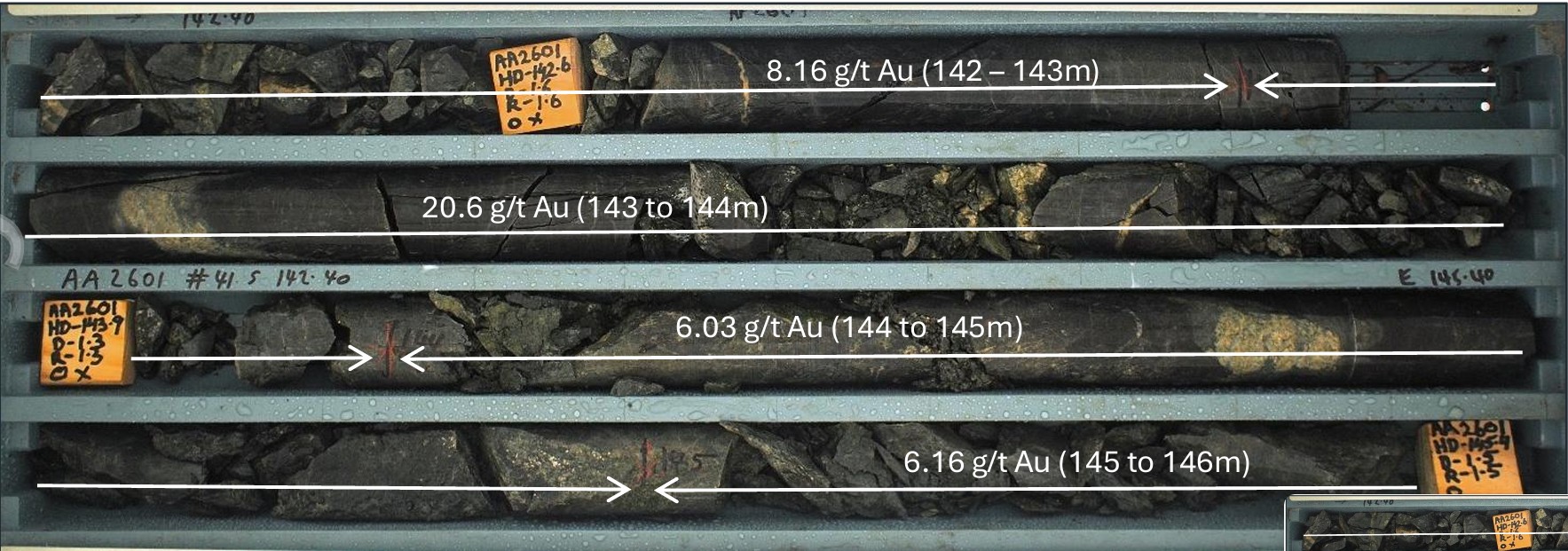
Width and grade, at shallow depth
Strip out the drilled-width flattery and the intercept is roughly 20 metres of true width at 2.62 g/t, with about 7 metres of true width at 5.13 g/t inside it. The company discloses both figures up front, which is more than many peers manage.
Twenty metres of continuous, mineralised true width is a bulk-tonnage geometry. This isn’t a half-metre bonanza vein that needs perfect underground selectivity to pay. It’s a wide mineralised envelope with a high-grade spine running through it, which is exactly the shape you want if you’re trying to build tonnes.
And it’s shallow. At a dip of −65 degrees, the intercept sits roughly 126 to 178 metres below the collar. That is squarely in the range where open-pit or shallow underground mining is on the table, with none of the cost or risk of a deep, narrow-vein development.
Put that grade against the current gold price. At around A$6,100 an ounce, rock running 2.62 g/t carries roughly A$510 per tonne of in-situ metal. Grades that would have been marginal in 2019 are now firmly in the conversation. The market has not fully re-rated shallow, wide, mid-grade Australian gold for the price environment we’re actually in.
Explore the Dig Fault Zone
Tap any drill hole for its collar, dip and status. Switch tabs for the full down-hole assay profile and for how this result sits against everything previously drilled at Apollo.
Apollo Gold Project: Dig Fault Zone
Interactive schematic · ASX:AM3 announcement, 8 September 2026 · Tap any drill hole for detail
Schematic only. Not a surveyed section. Hole collars, dips, azimuths and end-of-hole depths are as reported in Appendix 2 of the announcement. The Dig Fault Zone is drawn as a near-vertical, steeply west-dipping body consistent with the JORC Table 1 description; its width and continuity between holes are interpreted, not measured. AA2603 (azimuth 263°) and AA2604 (separate collar, ~98 m to the north-east) are projected onto this section and are shown for context only. Planned holes and the shaded zone below current drilling are conceptual and untested. Prior drilling shown on this section is filtered to intercepts grading above 1 g/t Au. Those intercepts are plotted at the down-hole depths reported by the relevant operator, but the hole traces carrying them are indicative only, because historic collar surveys are not published, so their position in space is interpretative and should not be read as surveyed. Intercept bars are coloured by grade × length in gram-metres, per the legend above. No Mineral Resource has been estimated for the Apollo Project.
Every 1 m assay reported in Appendix 1 of the announcement, plotted from 135 m to 200 m down-hole. Grades reported as < 0.01 g/t are plotted as zero. The 0.7 m interval at 140.3–141.0 m recorded no core recovery and has been assigned a grade of zero by the Company, and is included at zero here. Composite grades are length-weighted and reconcile exactly with the intervals reported by the Company. The top-cut control is illustrative only. No top cuts have been applied by the Company to the reported results.
Attribution. The intercepts attributed to previous explorers were reported by those explorers and were disclosed by the Company in its ASX announcement dated 14 February 2025. The 2025 maiden drilling results were disclosed in the Company's ASX announcement dated 6 October 2025, titled "Significant Gold Intersections Confirm Mineralisation at Apollo Gold & Antimony Project, Victoria". The Company has confirmed it is not aware of any new information or data that materially affects the information in those announcements, and that all material assumptions and technical parameters underpinning those results continue to apply and have not materially changed. In the contained metal view, bars show grade × length in gram-metres, the same measure used in the Company's own intercept legend. In the down-hole depth view, bars show where each intercept sits along its own drill hole. These are separate holes at different collars, dips and azimuths, so equal down-hole depths do not mean equal positions in space or equal vertical depths. All intercepts are down-hole lengths; true widths vary and are generally narrower. Historical results are not a guarantee of future results, and no Mineral Resource has been estimated for the Apollo Project.
| Attribute | Fosterville · Costerfield · Sunday Creek | Apollo · Dig Fault Zone | Apollo · Heyfield and Maindample reefs |
|---|---|---|---|
| Deposit model | Epizonal orogenic gold and antimony | Intrusion-related gold on a granite margin, a bulk-tonnage styleDISTINCT | Epizonal orogenic gold and antimonyMATCHES |
| Setting | Bendigo Zone (Fosterville); Melbourne Zone (Costerfield, Sunday Creek) | Melbourne Zone, Strathbogie granite contact, north end of the Walhalla BeltPARTLY | Melbourne Zone, same licenceMATCHES |
| Host rock | Folded Ordovician and Silurian turbidites | Strongly faulted and broken metasediments, plus the granite contact zonePARTLY | Sheared metasedimentsMATCHES |
| Gold mineralogy | Submicroscopic gold in sulphides; free gold rare in unoxidised ore; coarse visible gold in the deep bonanza zones | Electrum and calaverite (AuTe2) at ~15 microns, free grains 10 to 50 microns, in quartz muscovite veins and stockworkDISTINCT | Not disclosed |
| Sulphide link | Gold hosted within arsenopyrite, pyrite and stibnite | Gold appears unrelated to the sulphides, so recovery is not tied to sulphide behaviourDISTINCT | Disseminated arsenopyrite, pyrite and stibnite halosMATCHES |
| Pathfinders | Arsenic and antimony | Tellurium, the signature of an intrusion-related system, often with bismuth and tungstenDISTINCT | Arsenic and antimonyMATCHES |
| Geometry | Narrow veins and reefs, centimetres to a few metres | Broad envelope, about 20 m true width with a 7 m high-grade core, open at depthDISTINCT | Narrow reefsMATCHES |
| Grade character | Typically 5 to 15 g/t for underground mining, with bonanza grades in the deep transition zones | 2.62 g/t over 20 m true width, core at 5.13 g/t, from 126 m verticalDISTINCT | Not yet drilled by Amara |
| Nugget effect | High where coarse gold is present, as at the Fosterville Swan Zone | Low. Fine disseminated gold, which favours sample representivity and grade continuityDISTINCT | Unknown |
| Implied mining style | Selective underground | Bulk tonnage, shallow, open pit or shallow undergroundDISTINCT | Selective undergroundMATCHES |
Schematic and comparative only. The three panels above are conceptual illustrations of deposit style, not sections through any specific deposit, and are not to scale. Deposit model descriptions for the epizonal orogenic class follow the Geological Survey of Victoria. Apollo descriptions follow the JORC Table 1 in the Company's announcement of 8 September 2026 and prior operator disclosure. As the Company itself states, references to Fosterville, Costerfield and Sunday Creek are geological context only, and mineralisation at those projects does not guarantee similar results at Apollo. No Mineral Resource has been estimated for the Apollo Project.
What the schematic shows
Friendly geology, validated model
Two things about the Dig Fault mineralogy are quietly very good news.
First, the gold occurs as fine, disseminated grains: electrum and calaverite at roughly 15 microns, plus free grains at 10–50 microns. Fine disseminated gold means a low nugget effect. That translates directly into better sample representivity, tighter grade continuity between holes, and a resource model that behaves rather than lurching around. Anyone who has watched a coarse-gold Victorian project try to build a credible resource will understand why this matters.
Second, AA2601 reproduced the geological model almost exactly. The previous operator characterised the Dig Fault as a high-grade centre wrapped in a broad mineralised sulphide halo giving significant width. That is precisely what came back: a ~10-metre core at 8.04 g/t, a ~20-metre zone at 5.13 g/t, and a broader 57.5-metre envelope at 2.62 g/t. When a model predicts what the drill bit finds, subsequent holes become much better bets.
The catalyst calendar is dense
This is not a company that hits once and disappears for eighteen months:
- AA2602 and AA2603 are at the lab, with assays expected mid to late September. AA2602 is the same collar as AA2601 drilled steeper, meaning it tests directly beneath this intercept.
- AA2604 is turning now, from a new pad about 100 metres to the north-east, the first real test of strike continuity.
- A further three holes for roughly 2,000 metres are planned to test the Dig Fault below currently drilled levels. Mineralisation is open at depth.
- The rig returns to Lauriston in the December quarter, where the Comet and Trojan prospects sit adjacent to Agnico Eagle’s Fosterville mine and recent Trojan drilling has returned high-grade antimony.
That’s a news-flow cadence measured in weeks, not quarters, across two projects.
The cornerstone investor: Nova Minerals
In June, Amara raised A$2.2 million at A$0.005 a share, a 25 per cent premium to the last traded price of A$0.004 and an 8.5 per cent premium to the 10-day VWAP. Micro-cap placements almost always clear at a discount, sometimes a steep one. Pricing one above market and having it firmly subscribed tells you something about who was buying.
The cornerstone was Nova Minerals, which took A$500,000 of it: 100 million shares plus 50 million attaching options exercisable at A$0.008 and expiring 1 May 2029. That builds on the A$1 million Nova put in when it first became a strategic investor in September 2025, bringing its total to A$1.5 million across two raises. Nova chief executive Christopher Gerteisen has sat on the Amara board since May 2026.
Amara’s own board followed the money in: Chairman Mena Habib for A$75,000 and Managing Director Ian Holland for A$25,000, both subject to shareholder approval under Listing Rule 10.11. Buying your own stock at a 25 per cent premium to market is not a gesture.
Who Nova is
Nova is not a passive micro-cap punter. It completed a redomicile from Australia to the United States effective 16 June 2026 and now trades as Nova Minerals Corp on the NYSE American under NVA, with CHESS Depositary Interests still quoted on the ASX. After a 1-for-12 exchange it had 38,181,050 shares of common stock on issue, with market capitalisation of approximately US$234 million.
Its flagship is the Estelle Gold and Critical Minerals Project in Alaska’s Tintina Gold Belt: two multi-million-ounce gold resources including the 4.05 Moz pit-constrained Korbel deposit, and more than 20 prospects along a 35 kilometre trend. Recent Korbel flotation test work produced concentrate grading up to 26.7 g/t gold at recoveries above 95 per cent.
Nova’s antimony programme carries a US$43.4 million award from the US Department of War, non-dilutive, and engineering and design of its pilot plant is complete, with construction targeted from the third quarter of 2026 and pilot-scale production from late 2026 into early 2027. Nova entered the 2026 field season with more than US$60 million in cash and government funding, up to 10,000 metres of drilling planned and no debt.
That is the group that has now twice chosen to put money into a company capitalised in the mid-teens of millions, and that holds first call on its antimony.
The bottom line
First hole into the target, and it hit. Wide, shallow, validating the model, reported conservatively, on ground that cost less than a suburban house, in the strongest gold price environment on record, with the next three assays weeks away and mineralisation open at depth.
That’s a lot of things going right at once.
Disclosure and disclaimer. This article is general commentary based on publicly available information, including Amara Minerals’ ASX announcement of 8 September 2026. It is not financial advice. It does not take into account your objectives, financial situation or needs. Micro-cap exploration stocks are highly speculative. Do your own research and consider seeking licensed advice before making any investment decision. No Mineral Resource has been estimated for the Apollo Project, and the schematic on this page is illustrative only and not a surveyed section.