
by admin
Share
by admin
Share
AT4 Advances US Tungsten Strategy as Market Tightens
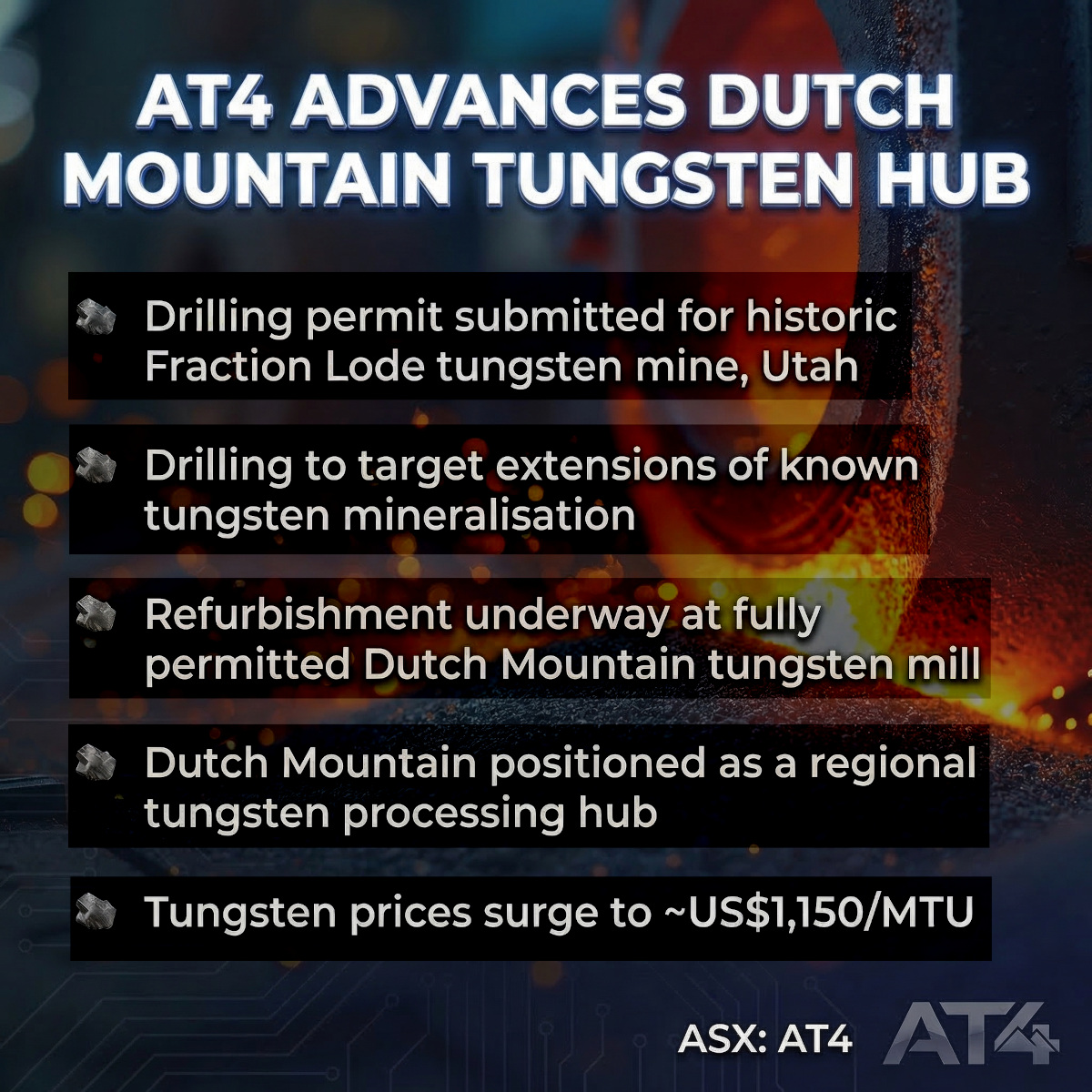
American Tungsten & Antimony (ASX: AT4) has taken another step forward in developing a domestic tungsten supply chain in the United States with the submission of a drilling permit for the historic Fraction Lode mine within the Dutch Mountain Project in Utah. The permit application allows the company to begin exploration drilling aimed at expanding known tungsten mineralisation at a historically productive mine in a well known tungsten district.
At the same time, refurbishment has begun at AT4’s Dutch Mountain tungsten processing mill, which sits on private land and is already permitted. This is significant because processing infrastructure is often the bottleneck in critical mineral projects. By bringing the mill back online while exploration progresses, the company is working toward a regional production strategy built around a central processing hub.
Hub and spoke strategy for US tungsten
AT4 is pursuing a regional hub and spoke development model. Dutch Mountain would act as a processing hub while surrounding tungsten projects supply ore to the mill. Alongside Dutch Mountain, the company is advancing the Tennessee Mountain and Nightingale tungsten projects in Nevada.
The concept is straightforward. Ore from multiple deposits could be processed through a central facility, reducing capital costs and allowing smaller deposits to become viable. Concentrates could then be refined into products such as ammonium paratungstate, tungsten oxide and tungsten powder.
The strategy reflects a broader push in the United States and allied countries to rebuild supply chains for critical minerals.
Why tungsten is suddenly in demand
Tungsten is one of the hardest metals on earth and has the highest melting point of any metal. These properties make it essential in industries that require materials capable of operating under extreme heat, pressure and wear.
Some of its most important uses include:
- Tungsten carbide cutting tools used in mining, manufacturing and drilling
- Armour piercing ammunition and military counterweights
- Aerospace components and turbine parts
- Semiconductor manufacturing and advanced electronics
- Oil and gas drilling equipment
- Industrial wear resistant machinery
Because it is extremely difficult to substitute in these applications, demand tends to remain strong even when economic conditions slow.
A supply chain dominated by a few countries
The tungsten market has long been vulnerable to supply disruptions. China dominates global production and processing, producing the majority of the world’s tungsten and controlling much of the downstream supply chain.
Export controls and tighter mining quotas have recently reduced supply available to international markets. At the same time, governments in the United States and Europe have started prioritising secure supply chains for strategic metals.
These dynamics have driven sharp price increases. Chinese tungsten product prices rose more than 200 percent in 2025 as supply tightened and demand strengthened across industrial and defence sectors.
Forecasts suggest the market could remain in deficit later this decade as demand continues to expand faster than new supply can be developed.
Defence demand and geopolitical tensions
One of the strongest drivers behind tungsten demand is defence spending. The metal plays a role in armour piercing munitions, missile components, aerospace counterweights and other military technologies.
As geopolitical tensions increase, defence spending is rising across many countries. This trend directly increases demand for metals used in weapons systems and military equipment.
Conflicts in the Middle East, including the current war involving Iran and regional powers, highlight the importance of secure defence supply chains. Modern weapons systems rely heavily on specialised materials like tungsten that can withstand extreme stress and heat. When military production accelerates, demand for these metals follows.
In practical terms, conflict often increases demand for ammunition, armoured systems and aircraft. Tungsten is widely used in armour piercing projectiles and heavy duty components, meaning prolonged conflicts tend to support higher consumption of the metal.
A strategic metal entering a new cycle
Tungsten is moving from being an overlooked industrial metal to a strategic commodity. Governments are increasingly aware that supply chains concentrated in a handful of countries create vulnerabilities for defence and advanced manufacturing.
As a result, Western countries are encouraging the development of new mines, processing facilities and refining capacity.
Projects like AT4’s Dutch Mountain strategy are positioned within this broader trend. By advancing exploration while refurbishing processing infrastructure, the company is attempting to establish a foothold in a sector where secure supply is becoming increasingly important.
If current trends continue, tungsten demand could remain strong for years to come. Rising defence spending, advanced manufacturing, electronics, and strategic stockpiling are all pointing toward a tighter market and a renewed focus on developing tungsten resources outside traditional supply centres.