
by admin
Share
by admin
Share
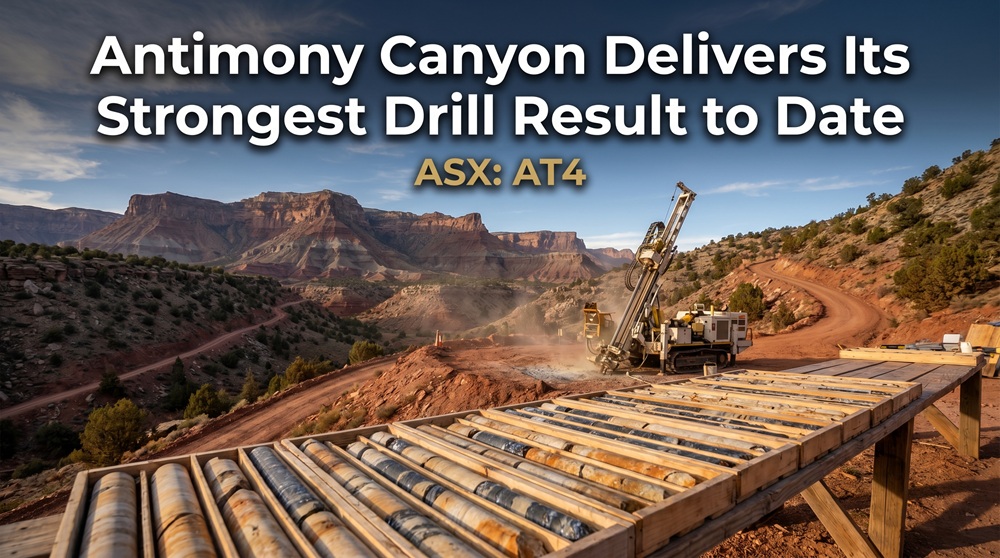
American Tungsten & Antimony (ASX: AT4, OTCQB: ATALF) put out a drilling update on 5 June 2026 that’s worth unpacking, not just because the grades are genuinely eye-catching, but because of where this company sits in one of the more deliberate critical-minerals strategies you’ll find on the ASX.
Inside the AT4 Drill Update
The headline is from the Little Emma Prospect at the 100%-owned Antimony Canyon Project in Garfield County, Utah. Across 17 holes of Phase 1 diamond drilling reported in this release, the standout is hole ACP26DD026, which returned 10.37m at 3.98% antimony from just 3.35m down the hole and within that, a cracking 4.57m at 8.56% Sb from 6.71m. A single sample inside that pod hit 42.1% Sb, the highest individual grade of the programme.
Backing it up was ACP26DD014: 5.7m at 2.80% Sb from 48.68m, including 1.95m at 8.09% Sb. These build on results AT4 reported back in March 2026, including an 11.03m intercept at 3.1% Sb (with a 2.62m core at 12.54%) in hole DD010.
To put those numbers in context: antimony “ore” is often talked about in the low single-digit percentages, so multi-metre intervals averaging 3–4% with cores running 8% and spikes above 40% are, on their face, very high grade. Managing Director Andre Booyzen leaned into that, framing DD026 as the strongest result of the programme and stressing that the majority of the 17 holes hit the target horizon and that Little Emma is just one of more than 20 historic workings on the claims, representing barely 1% of the project footprint.
The Geology: A “Poddy” Replacement System
The interesting story here is the deposit model, because it shapes how the rest of the project might play out.
AT4 describes Antimony Canyon as a stratabound, replacement-style system rather than the structurally-controlled vein systems that dominate a lot of antimony deposits. Mineralisation sits within a porous calcareous tuff unit nicknamed the “Salt and Pepper” horizon, part of the Paleocene Flagstaff Formation. The interpretation is that acidic, antimony-bearing hydrothermal fluids dissolved carbonate in the host rock and replaced the pore space with stibnite, meaning grade is controlled by where the rock was most porous and reactive, not just by faults.
The practical upshot is “poddy” geometry: high-grade massive-stibnite pods (the 8–42% intervals) sit inside broader, lower-grade envelopes of disseminated mineralisation (the 0.26–0.38% “inter-pod matrix”). Holes DD024 and DD025 hit those broad low-grade envelopes. DD025 returned 12.1m at 0.26%, the widest single composite of the programme. That matters because it tells AT4 the host horizon is laterally continuous over 250m-plus, and that more high-grade pods could be sitting nearby, untested.
The company also points to a useful exploration tool: a multi-element pathfinder “fingerprint” of arsenic, mercury, thallium and molybdenum that flags the margins of high-grade pods. That gives geologists a chemical vector to chase pods in Phase 2, which is genuinely helpful in a replacement system where you can’t just follow a vein.
AT4 draws a comparison to the Xikuangshan district in Hunan, China, the world’s largest antimony deposit, with historic production north of 2 million tonnes of contained antimony, on the basis of a shared stratabound, carbonate-replacement model.
Antimony: State of play
The backdrop is what makes this more than just another junior drill update.
Antimony is essential to a lot of industrial work, flame retardants, lead-acid batteries, alloys, semiconductors: but it’s the defence angle that’s driven the recent frenzy.
It goes into ammunition primers, military alloys, night-vision optics and infrared sensors, which is why the US treats it as a strategic critical mineral.
Primary production and especially refining are heavily concentrated in China, with Tajikistan, Russia, Bolivia and Myanmar making up much of the rest. When Beijing added antimony to its export-control list in August 2024 and tightened further through 2025, prices went vertical, from around US$12,000–15,000/tonne to north of US$60,000/tonne at the early-2026 peak, roughly a fivefold move.
Pricing has since eased off those highs: China announced in November 2025 it would suspend export bans on antimony (and gallium and germanium) bound for the US for civilian use, with that suspension running to late November 2026, which has taken some heat out of the market. Recent spot pricing has sat in a broad US$38,000–50,000/tonne band.
The strategic takeaway for a company like AT4: even with Chinese supply partly back in play, Western governments have decided that depending on it is a risk they’re no longer willing to carry. That’s structural demand for non-Chinese, “conflict-free” supply, exactly the niche AT4 is positioning itself in.
The AT4 Edge: Utah, Patented Claims, and Mine-to-Metal
This is where AT4 genuinely stands apart from most explorers, and it ties straight into how the US is funding this sector.
Patented claims = speed. Most of the Little Emma drilling sits on patented mining claims, meaning AT4 owns the surface and mineral rights outright. The big advantage is permitting: on private patented ground, approvals run through the Utah Division of Oil, Gas and Mining (DOGM) at state level rather than through lengthy federal processes. AT4 secured approval for a 24-pad drill programme in December 2025, the kind of thing that can take years on public land.
State-level incentives. Utah has been aggressively courting this sector. AT4 secured a 40% state tax credit under Utah’s Rural Economic Development Tax Increment Financing (REDTIF) program for Antimony Canyon, and via its US entity has been tied to a post-performance tax reduction linked to a projected 400 jobs and US$287 million-plus of investment, including plans for one of the first modern antimony tertiary refining facilities in the US. Governor Spencer Cox has been an open champion.
Federal money is flowing to the sector too. The broader US approach has been muscular: the Department of Defense has put more than US$59 million into Perpetua Resources’ Stibnite Gold project in Idaho, and in September 2025 the (now-renamed) Department of War handed a US$43.4 million Defense Production Act Title III grant to a Nova Minerals subsidiary for a domestic military-grade antimony trisulfide supply chain in Alaska. AT4 has been engaging at this level, its MD has met with Department of War and Department of Energy representatives about development pathways.
Mine-to-metal, not just mine. Unlike a pure explorer, AT4 is pushing the whole value chain. In February 2026 it produced its first antimony ingots from Antimony Canyon material in metallurgical testwork, following a Metso Ausmelt concept study and plant design that the company says points to a smelter within roughly two years. It’s also flagged a proposed Nasdaq listing to access deeper capital markets.
It’s worth noting the contrast with the Australian approach, for local readers. Victoria recently launched a $1 million Advancing Antimony Grants program aimed at feasibility-stage work on downstream processing (applications close 23 June 2026), leaning on the fact it hosts Australia’s only operating antimony mine at Costerfield and some of the largest deposits in the Western world. It’s a more modest, earlier-stage nudge than the US model of direct defence cheques plus state tax incentives plus high-level political backing. AT4 has effectively chosen to chase the bigger, faster pool of US support by basing its flagship there.
Summary
The geology at Antimony Canyon is doing what you’d want it to at this stage: consistent intercepts of the target horizon, very high-grade pods, a coherent and (importantly) predictable replacement model, and a pathfinder toolkit to vector toward more pods. The DD026 result is a legitimately strong number, and the lateral continuity shown by the broad low-grade holes is arguably just as significant for the longer-term story.
The macro tailwind is real and unlikely to fade quickly even with Chinese exports partly flowing again, and AT4’s combination of patented-claim permitting speed, Utah state incentives, and a mine-to-metal ambition gives it a clearer strategic path than most juniors. The execution risk sits in converting that into a defined resource and an actual operating smelter; and that’s where the next 12 months of news flow will tell the story.