
ASX: AKN · Qeqertaasaq Niobium–Rare Earths Project · West Greenland
AuKing moves into Greenland with a drilled, high-grade niobium and rare earths project
AuKing Mining has secured the right to earn up to 75% of the Qeqertaasaq carbonatite complex near Nuuk, with no upfront acquisition cost. The project comes with five decades of exploration data. It sits in a West Greenland critical-minerals province that is drawing global attention after the 2026 US–Denmark–Greenland security treaty, and after President Trump’s 14 October statement that “massive” mineral exploration is about to begin in Greenland.
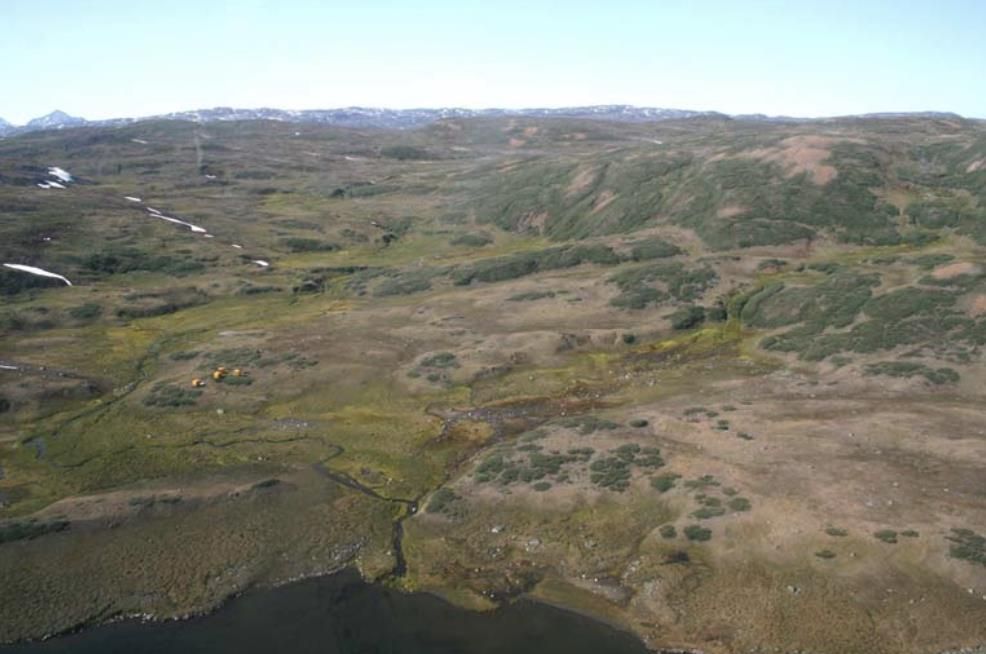
Investment highlights
Why Qeqertaasaq stands out
No upfront acquisition cost
AuKing earns its interest by funding exploration, so every euro goes into the ground. The company can increase its investment step by step as historical results are confirmed.
Thick, shallow niobium
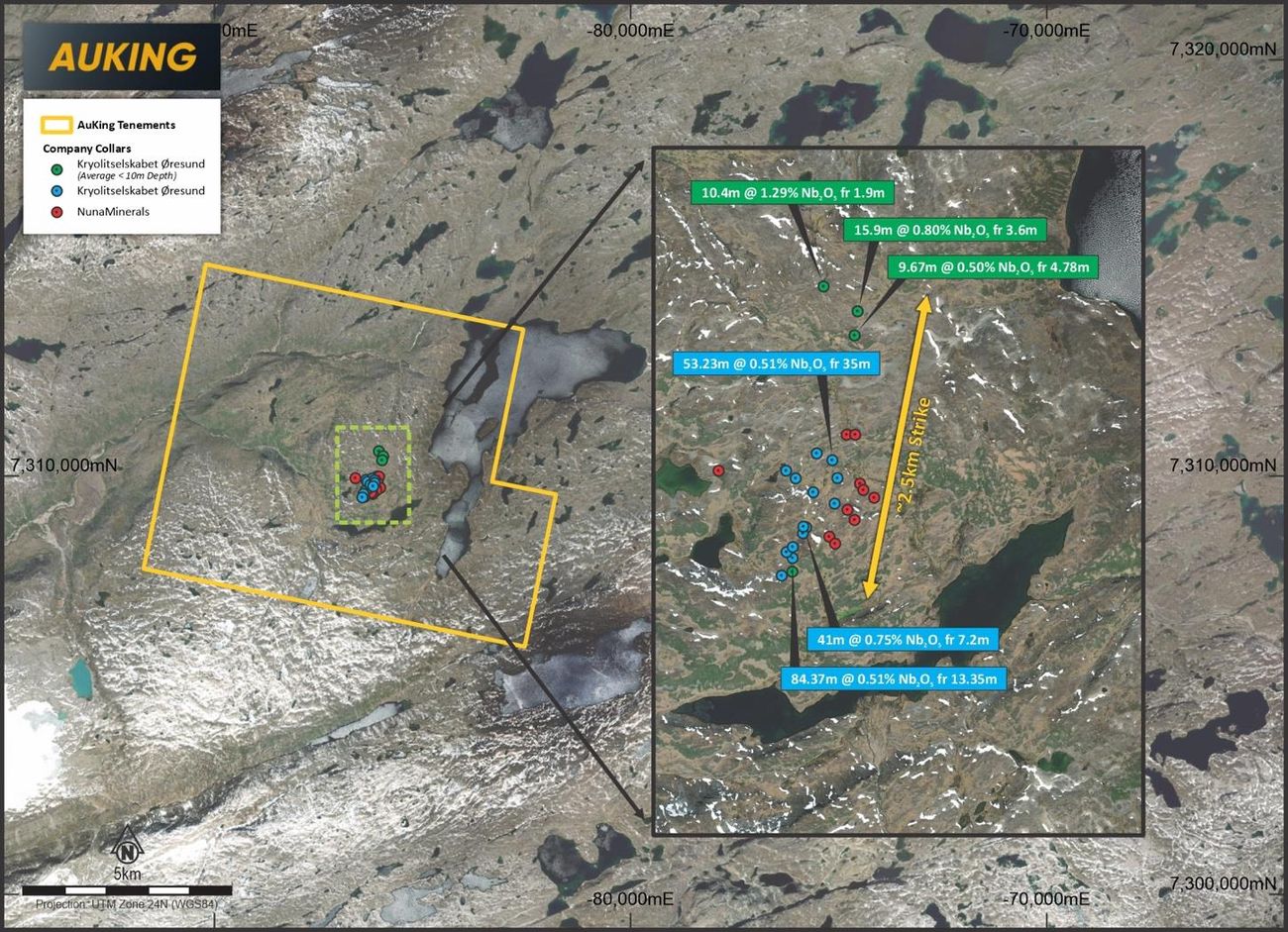
Historical drilling hit long intervals of pyrochlore mineralisation from near surface: 84.37 m @ 0.51%, 53.23 m @ 0.51% and 41 m @ 0.75% Nb₂O₅. The original explorers judged the main zone suited to open-pit mining.
A second commodity: rare earths
The neodymium-rich “Discovery Vein” runs more than 750 m along strike and at least 200 m down dip, and stays open. Trenches returned up to 13.23% TREO.
Encouraging metallurgy
Testwork in 2011 recovered up to 82% of the rare earths from coarsely crushed ore, using mild hydrochloric acid at 50 °C. It needed no fine grinding or pre-concentration.
District-scale system, open in all directions
One 64 km² licence covers the whole carbonatite complex. Untested radiometric targets and tantalum float samples of up to 1% Ta₂O₅ add further discovery potential.
The right investor in the right place
Greenland’s new treaty restricts investors from outside NATO, its partners and the EU in resource extraction. Australian-listed AuKing is on the favoured side of that line.
Location
Where Qeqertaasaq sits
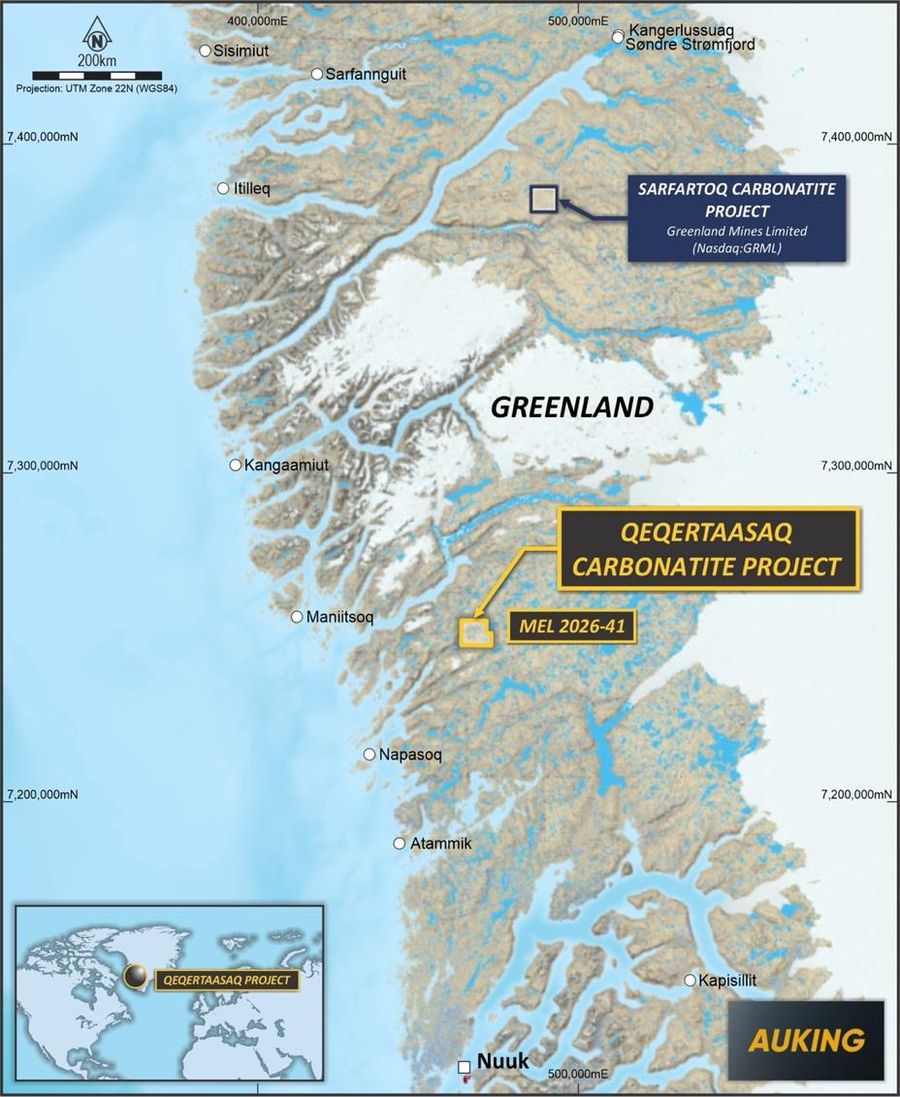
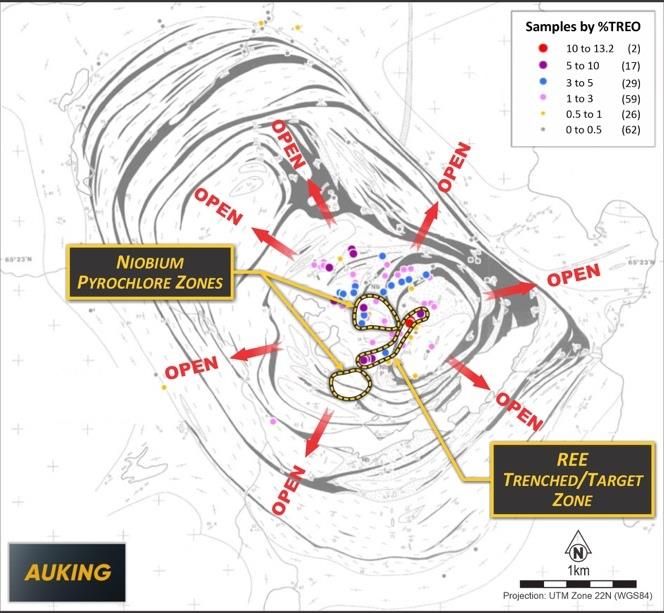
The licence lies about 125 km north-north-east of Nuuk and 55 km east of Maniitsoq, in the same West Greenland carbonatite province as Greenland Mines’ Sarfartoq project. Historical drilling is clustered over a 2.5 km niobium trend in the centre of the complex.
Transaction
A low-cost, staged entry
AuKing has signed a binding term sheet with Xploration Services Greenland A/S. That company has more than 20 years’ experience in exploration, logistics and administration in Greenland, and will run field work under a joint management committee. AuKing sole-funds €10 million of exploration over up to six years, and each stage is at its option. Select a stage to see AuKing’s position.
AuKing’s position after Stage 1
Annual minimum licence spend is modest: about A$69k in 2027 and A$215k in 2028. On completion of the earn-in, an introduction fee of 10% of project equity is allocated to the third parties who introduced the deal. Starting the earn-in is subject to ASX confirming that Chapter 11 re-compliance is not required.
Niobium drilling
Explore the historical drill results
Kryolitselskabet Øresund (KØ), a pioneering Danish explorer, drilled the niobium zones in 1975 and 1976. The sample-by-sample assays survive in KØ’s 1976 report. Pick a hole to see its 1976 sample assays down the hole, with AuKing’s reported intercept shaded.
| Hole | Year | Intercept (% Nb₂O₅) | Including |
|---|---|---|---|
| Qa-11 | 1976 | 84.37 m @ 0.51% from 13.35 m | 43.96 m @ 0.81% from 32.94 m 32.43 m @ 1.06% from 44.47 m |
| Qa-25 | 1976 | 53.23 m @ 0.51% from 35 m | 26.18 m @ 0.83% from 57.3 m 15.93 m @ 1.11% from 72.3 m |
| 17593 | 1975 | 41 m @ 0.75% from 7.2 m | – |
| 17636 | 1975 | 15.9 m @ 0.80% from 3.6 m | – |
| 17590 | 1975 | 9.04 m @ 0.51% from 2.65 m | – |
| 17622 | 1975 | 9.67 m @ 0.50% from 4.78 m | 5.26 m @ 0.80% from 6.57 m |
Intercepts as reported by AuKing Mining (ASX announcement, 13 October 2026), from KØ’s 1975–76 drilling. Downhole widths; true widths are not known. Results are historical and not reported under JORC 2012 (see the cautionary statement below).
Shallow, near-surface niobium
Pyrochlore, the same niobium mineral mined in Brazil and Canada, is concentrated in apatite-magnetite rock and brown glimmerite. These form a swarm of mineralised horizons within the carbonatite. The 1975 holes averaged under 10 m deep and hit niobium almost from collar: 15.9 m @ 0.80% Nb₂O₅ from 3.6 m in hole 17636, and 9.04 m @ 0.51% from 2.65 m in hole 17590.
KØ described the main Anomaly 2 zone, on the slope of hill 442, as a body that “could rather easily be exploited by open pit methods”. It flagged room to grow in Anomaly 3, where “doubling of reserves in these bodies should therefore not be impossible”.
Compared with a producing mine
Niobec in Québec supplies about 7–8% of world niobium from mineralised envelopes averaging 0.37–0.42% Nb₂O₅ (IAMGOLD NI 43-101, 2013). Several Qeqertaasaq intercepts start within 10 m of surface. Grades shown are drilled intercepts, not resource grades.
Rare earths
A high-grade rare earth vein system
The rare earths sit in steep carbonatite veins rich in ancylite-(Ce), mainly in the south-east core of the complex, with lower-grade halos tens of metres wide. NunaMinerals explored them between 2007 and 2014, with Korea’s state resources agency KORES joining in 2014. That work included 30 drill holes and trenching. NunaMinerals reported rare earths in high-grade veins in every 2011 hole, with widths up to 6 m.
The Discovery Vein carries up to 4.5% TREO over 4.7 m. It has been traced for more than 750 m along strike and at least 200 m down dip, and remains open. About 14.5% of its TREO is critical rare earths, led by neodymium, a key magnet metal. Soil sampling in 2012 points to further concealed REE and niobium mineralisation nearby.
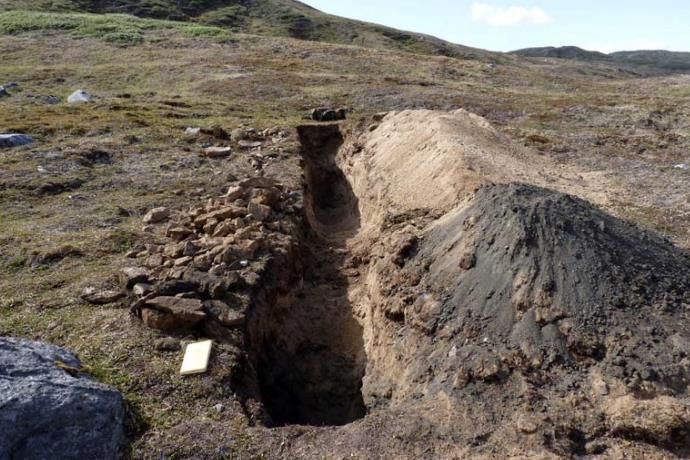
2010 trench highlights
Each trench was mineralised across its sampled length. Peak assay 13.23% TREO. Source: NunaMinerals 2010.
2011 leach testwork (IntelliMET)
A later test on Discovery Vein material also reported more than 80% recovery from coarsely crushed ore. The carbonate-rich mineralogy leaches quickly, which supports a simple, low-energy front end.
Proposed niobium flowsheet
- Minenear-surface ore
- Crush & screen
- Grind & classifyliberate pyrochlore
- Upgradegravity / magnetic
- Flotationpyrochlore float
- Cleaningregrind & clean
- Nb concentrate
Proposed rare earth flowsheet
- Mine
- Crush & screen
- Gravity separationdense REE minerals
- REE concentrateproduct route
- HCl leachif required
- Purify
- Mixed RE carbonate
Market
Niobium: a strategic metal with one dominant supplier
Niobium makes steel stronger and lighter in tiny amounts. It is essential to pipelines, cars, bridges and the superalloys in jet engines and rockets. In the US, steel takes about 77% of consumption and superalloys about 23%.
Supply is highly concentrated. Brazil produces about 93% of the world’s niobium, and Canada most of the rest. The United States mines none and imports 100% of its needs, so niobium appears on US, EU and Australian critical-minerals lists. A new source in a NATO-aligned jurisdiction answers a clear strategic need.
Qeqertaasaq also has tantalum potential (float samples up to 1% Ta₂O₅), along with vanadium-bearing magnetite and apatite. The 1976 explorers expected these to “gain an increasing importance in economic evaluations”.
Mined niobium, 2025 estimate
Tonnes of contained niobium. Source: USGS Mineral Commodity Summaries 2026.
Geopolitics
Greenland’s moment
Greenland moved to the centre of Western strategy in 2026. After months of US–European tension over the island’s future, the United States, Denmark and Greenland signed a trilateral security treaty at the UN General Assembly on 22 September 2026. It amends the 1951 defence agreement, and Greenland signed as a full party for the first time. The treaty has no expiry date.
AuKing’s release notes that the treaty explicitly recognises Greenland’s critical-mineral endowment and its importance to Western security and supply chains. Its investment provisions matter most for explorers. Investors from outside NATO, NATO partner states and the EU cannot take control, significant influence or sensitive information in “particularly sensitive sectors”, resource extraction included, without the agreement of all three governments.
Massive Oil, Gas, and Mineral Exploration is getting ready to begin in our new and beautiful Greenland! … from a Security Purpose in the Defense and Offense of both the United States of America, and Europe, is second to none.President Donald J. Trump, Truth Social, 14 Oct 2026, 12:17 AM ET (excerpt)
The White House followed the treaty with a clear signal. Posting just hours after AuKing announced its Greenland entry, President Trump said “massive” oil, gas and mineral exploration is “getting ready to begin” in Greenland, and called the island’s security value “second to none”. The message is that resource development in Greenland is now a stated US priority alongside defence. For mineral explorers this matters more than for oil. Greenland stopped issuing new oil and gas licences in 2021, but its mineral licensing remains open, which is where AuKing and its peers operate.
2026 timeline
- 21 JanAt Davos, the US announces a “framework” with NATO for Greenland that includes cooperation on mineral development.
- 17 AprGreenland approves Critical Metals’ move to 92.5% of the Tanbreez rare earths project.
- 18 SepThe US announces the trilateral security agreement.
- 21 SepGreenland-focused stocks rally. Greenland Mines rises up to 206% intraday and Critical Metals 25%.
- 22 SepThe treaty is signed at the UN in New York.
- 13 OctAuKing announces the Qeqertaasaq earn-in.
- 14 OctPresident Trump posts that “massive oil, gas, and mineral exploration” is about to begin in Greenland.
- 14 OctAuKing releases its investor presentation on the acquisition.
Market momentum
Greenland’s critical-minerals names are being re-rated
Investors have been paying up for exposure to Greenland’s critical minerals. The two most prominent listed names are more advanced than Qeqertaasaq, but both show how the market is valuing the region.
Critical Metals Corp · NASDAQ: CRML · CEO Tony Sage
Tanbreez, South Greenland
- Market cap
- US$920M (US$6.26 × 147.0M shares, close 14 Oct 2026). Earlier peaks: over US$2B in January and about US$1.4B in April
- Commodity
- Heavy rare earths, with hafnium, gallium and niobium
- Status
- Holds an exploitation licence. Feasibility study targeted for end 2026
- 2026
- Up about 150% year-to-date by late January. 92.5% ownership approved in April. Offtake with Ucore’s Louisiana plant. Up to US$120M in potential US EXIM financing. +25% on 21 Sep
Tony Sage aims to cut China’s 97% grip on heavy rare earths to about 50% within three years. He describes “an independent Greenland, but with a heavy U.S. defense presence” as the ideal outcome.
Greenland Mines · NASDAQ: GRML
Sarfartoq, West Greenland
- Market cap
- US$86.6M (US$6.49 × 13.35M shares, close 14 Oct 2026), up from about US$21M at the end of 2025
- Commodity
- Rare earth magnet metals in a carbonatite
- Status
- Exploration. Company cites a US$2.05B high-case NPV for its Sarfartoq deposit
- 2026
- Expanded its district to about 454 km². Shares rose up to 206% intraday on 21 Sep
- Funding
- Raised more than US$59M in the week to 29 Sep, at US$12–13 per share
- Link
- The nearest carbonatite peer, in the same West Greenland province as Qeqertaasaq
AuKing Mining · ASX: AKN
Qeqertaasaq, West Greenland
- Commodity
- Niobium and rare earths, with tantalum potential
- Status
- Advanced exploration with 50 years of data, moving toward a maiden JORC resource
- Entry
- No upfront cost. €10M of optional exploration funding for 75%
- Edge
- Allied investor under the new treaty, with year-round helicopter access
Company
Part of a growing critical-minerals portfolio
In early 2026 AuKing reset its strategy around critical minerals and rebuilt its portfolio. Qeqertaasaq is its latest addition.
- Oct 2026Qeqertaasaq, Greenland · niobium and rare earthsHigh-strength steels, superalloys, defence
- Apr 2026Tundulu, Malawi · 5 km carbonatite ring complex, rare earthsPermanent magnets, EVs, defence. 15,000 m drilling under way
- Jan 2026Big Wilson, Tasmania · tin and tungsten, next to Renison BellElectronics, defence, hard metals
- OngoingKoongie Park, WA · copper and zinc. Cobalt Blue (ASX: COB) can earn up to 75% by sole-fundingElectrification. JORC resource, JV-funded
- OngoingMkuju, Tanzania · uranium near the Nyota depositNuclear baseload
Catalysts
What comes next
AuKing’s first step is a full compilation of the historical database: more than 10,000 m of drilling, plus surface and trench sampling and metallurgy. That work sets up a focused resource drilling program.
- Oct 2026Due diligence completes. ASX confirmation on Chapter 11.
- Next phaseCompile and review historical data, and plan drilling and metallurgy.
- DrillingResource definition drilling of about 3,000–5,000 m toward a maiden Inferred Mineral Resource.
- MetallurgyBench-scale testwork to verify historical results and design the beneficiation flowsheets.
- Sep 2028Stage 1 completes: €3M spent, 30% earned.
One of the key reasons for securing Qeqertaasaq is the significant data base of historical exploration, including more than 10,000m of drilling since the mid-1970s.Paul Williams, Managing Director, AuKing Mining
The project is about 125 km north-north-east of Nuuk and 55 km east of Maniitsoq, 18 km from the head of Kangia Fjord. AuKing reports year-round access, with a 20-minute helicopter flight from major airports and deep-water fjord access for most of the year.
A low-cost entry into Greenland’s critical-minerals story
Qeqertaasaq combines a drilled, near-surface niobium system with a high-grade rare earth vein. AuKing holds it through a staged, low-cost earn-in, at a time when Western governments are prioritising Greenland’s resources and allied investment.
Important information
Notes and disclaimer
Cautionary statement on historical results
The historical exploration results in this report were not reported under the JORC Code 2012, and a Competent Person has not done enough work to report them under the Code. Further evaluation or exploration may reduce confidence in them once they are reported under JORC 2012. AuKing has said that nothing has come to its attention that questions their accuracy or reliability, but it has not independently validated them.
Key risks
Like all early-stage exploration, the project carries risk. No JORC Mineral Resource exists yet. Historical data must be verified by new drilling. The earn-in depends on due diligence, ASX confirmation and AuKing funding each stage. Greenland permitting includes its 2021 Uranium Act, which limits uranium content in mining projects. The treaty is awaiting ratification. Niobium and rare earth prices and markets may change.
Disclaimer
This report is for general information only. It is not financial advice or a recommendation to buy or sell any security, and it does not consider any person’s objectives, financial situation or needs. Readers should do their own research and seek independent advice.