
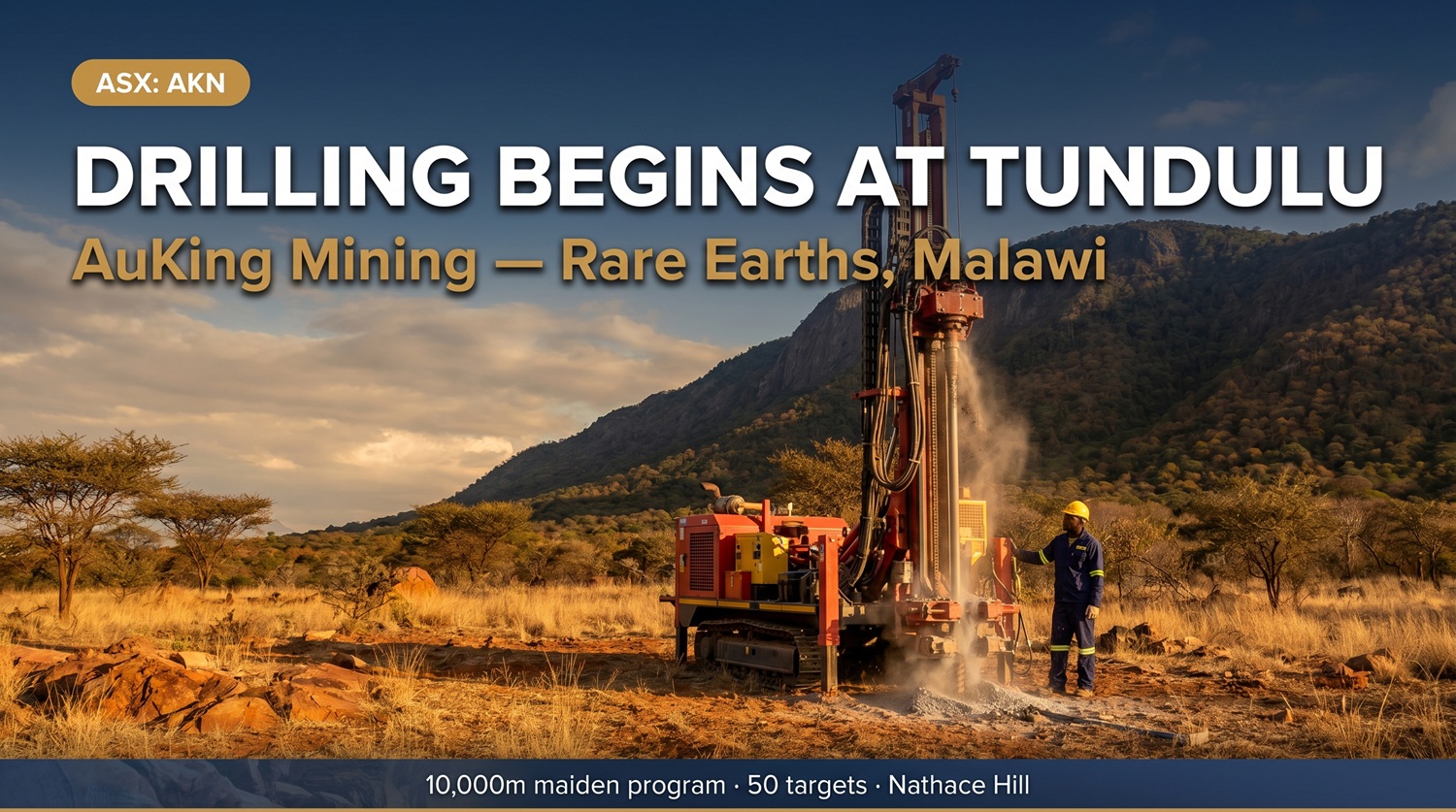
Drilling Underway at Tundulu as Rare Earths Re-Rate Gathers Pace
A district-scale carbonatite system. A 10,000-metre maiden program. A rare earths market in structural deficit, and AuKing Mining is moving decisively to capitalise.
A district-scale opportunity, freshly mapped
AuKing Mining (ASX: AKN) has commenced its maiden drilling program at the Tundulu Rare Earths Project in southern Malawi, a defining shift from interpretation to execution at one of the country's largest and most under-explored carbonatite systems.
Tundulu is a five-kilometre-diameter intrusive carbonatite complex, a geological setting that ranks among the world's premier hosts for rare earth mineralisation. AuKing is acquiring 100% of the project from Tusker Minerals (ASX: TSK), with an earn-in agreement securing operational access while the licence transfer progresses through Malawi's Mining and Minerals Regulatory Authority.
A game-changing airborne survey
AuKing's recently completed drone-based magnetic and LiDAR survey, the first modern airborne geophysical dataset over the project, fundamentally reshaped the opportunity. It confirmed that historical drilling tested only a limited portion of a much larger carbonatite complex centred on Nathace Hill, with significant areas remaining unexplored beneath shallow sedimentary cover.
The data resolved ring-style intrusive architecture and structural controls across an approximately 3km-scale system, flagging multiple new, drill-ready targets: untested intrusive margins, structural corridors and possible demagnetised zones.
A substantial, disciplined campaign
AuKing has engaged respected southern African contractor Thompson Resources for a planned 10,000-metre program of combined reverse circulation (RC) and diamond drilling across approximately 50 targets, with provision to extend significantly. An RC rig is already on site and turning; a diamond rig is due to mobilise this month.
- Nathace Hill: priority holes chasing southwest extensions and the southern corridor, including step-out, infill and three twin holes to validate historical results, plus a deep (~500m) diamond hole to test vertical extent and core architecture.
- Tundulu Hill: angled and vertical fence holes probing intrusive geometry and high-grade zones beneath historic surface and shallow intersections.
- Satellite targets: scout RC drilling across zones with surface geochemistry exceeding 1% TREO, and locally greater than 3% TREO.
First assays are bound for Intertek's Perth laboratory in the coming weeks, establishing a steady cadence of news flow through the second half of 2026.
The macro backdrop and investment case
The timing is difficult to fault. NdPr oxide, the magnet workhorse for EV motors and wind turbines, roughly doubled over the early part of 2026, climbing from around US$53/kg in January to above US$108/kg by early March, on Chinese export discipline and a second consecutive year of structural deficit.
With China accounting for roughly 60% of mined magnet rare earths and around 91% of refined output, Western governments and end-users are urgently seeking diversified, ex-China supply. AuKing holds a large, advanced exploration asset at precisely that moment.
Drilling is underway. Assays are weeks away. The catalyst calendar is about to accelerate.
Visit AuKing Mining →This commentary is general in nature, prepared for informational purposes only, and does not constitute financial advice. The author is not a licensed financial adviser. Junior mining explorers carry elevated risk and exploration outcomes are inherently uncertain. Conduct your own research and consult a licensed professional before making any investment decision.