
by admin
Share
by admin
Share
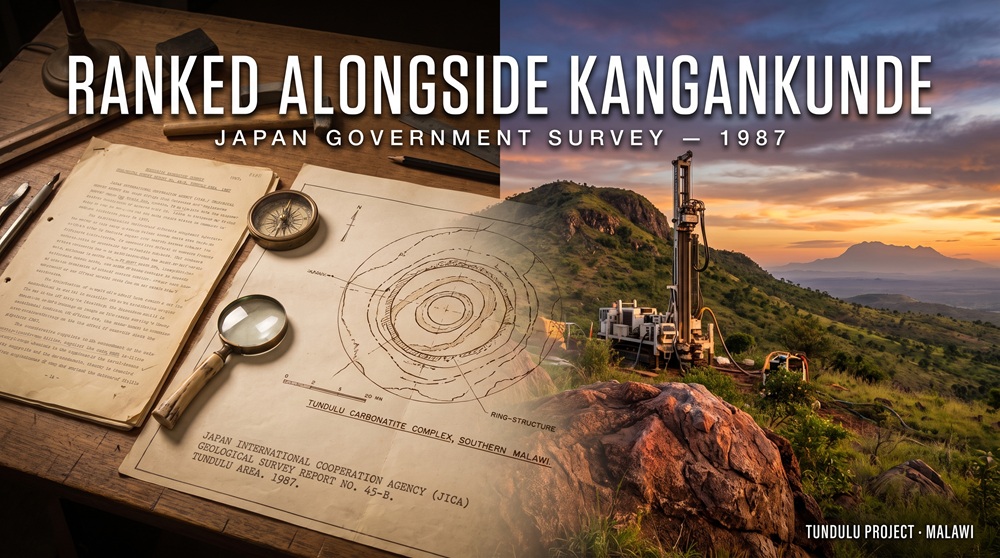
Between 1986 and 1988, the Japan International Cooperation Agency (JICA) and the Metal Mining Agency of Japan ran a three-phase exploration programme across Malawi’s Chilwa Alkaline Province: 30,000 square kilometres screened, 25 target sectors assessed, around 1,000 geochemical samples analysed, and the best targets drilled.
Its findings on the Tundulu Project (now ASX:AKN) still read remarkably well today:
▪ Ranked in the top four of all 25 sectors, listed alongside Kangankunde and Songwe
▪ One of only three sectors anomalous in all 15 rare earth pathfinder elements, a distinction Kangankunde did not achieve
▪ Strong anomalies in dysprosium, terbium and yttrium, the heavy rare earths, where Kangankunde’s were the lights
▪ Drilling at Nathace Hill returned a preliminary estimate of 0.6Mt at 2.09% REO, grades the report compared to Bayan Obo, capped at just 50m depth on one hillside
▪ A phosphate estimate of 17% P2O5, which the report graded above Brazil’s Araxá Mine
▪ Final recommendation: further detailed drilling to grow the reserves
That recommendation sat unanswered for decades. AuKing’s 10,000m drill programme is now testing the system at depth for the first time, with assays pending.
Historical, pre-JORC results and estimates, not verified by a Competent Person and not to be relied upon; see the full analysis and cautionary statement here: Japanese Government Report on Tundulu