
by admin
Share
by admin
Share
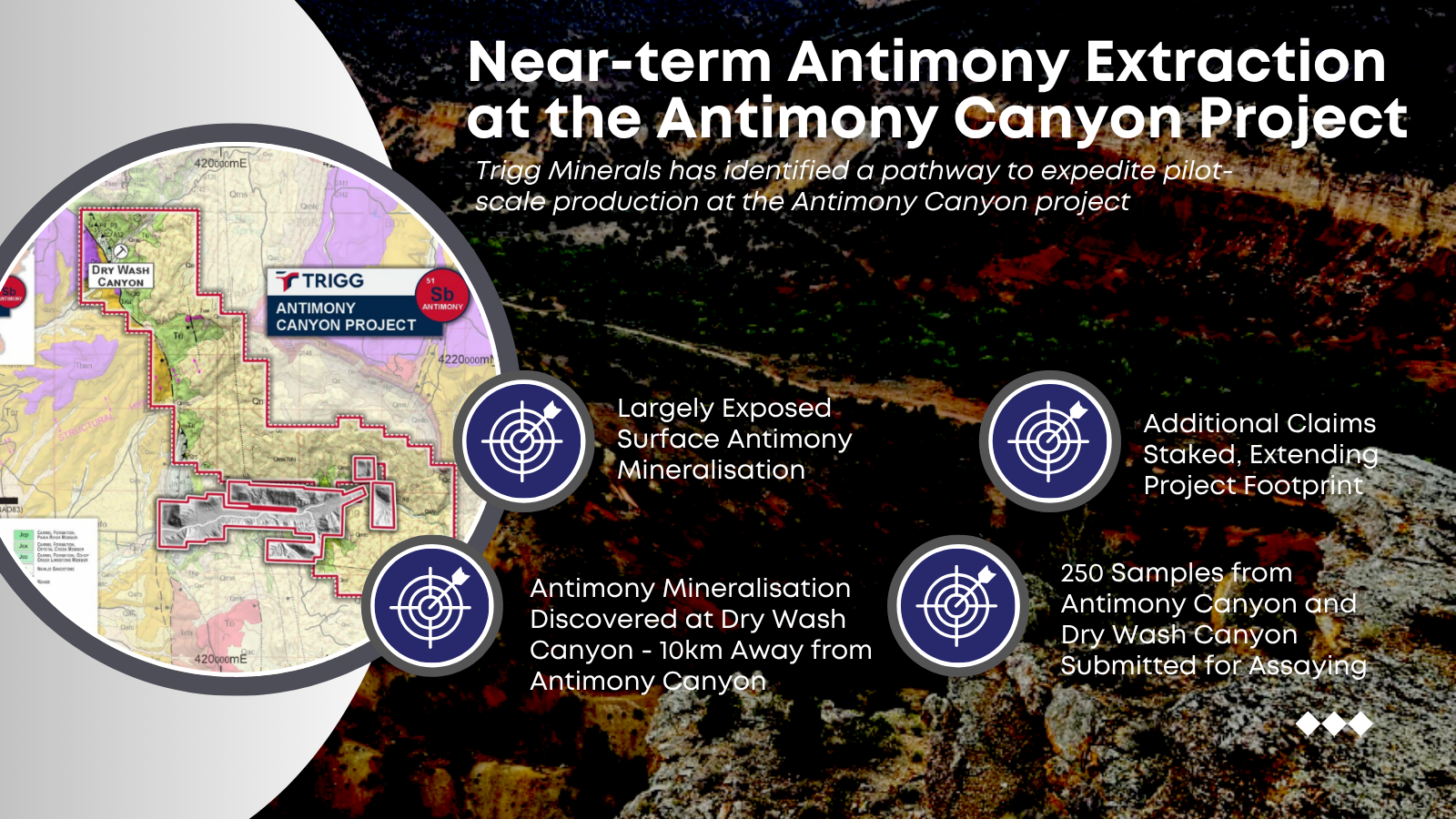
Trigg Minerals has announced accelerated plans for near-term, pilot-scale antimony extraction at Antimony Canyon, as it seeks to expedite a solution to the growing antimony supply deficit in the United States.
At Antimony Canyon, the defined mineralised zones are largely exposed at surface, enabling low-cost and imminent scalable evaluation, while Trigg continues exploration at depth and across other underexplored high-priority zones.
There are over 30 past-producing antimony mines and adits within the Antimony Canyon Project, where mineralisation remains open, positioning the project for rapid development. The mines were previously operated until the 1960s, with mining activities ceasing due to weak antimony prices. Additional production occurred during periods of elevated Sb prices, such as during World War I.
In light of the recent spate of global conflicts and trade tensions—particularly China’s export restrictions on antimony and other critical minerals—Trigg Minerals has received strategic interest regarding the securing of both immediate and long-term antimony feedstock. Proposals have also included the potential uplisting of Trigg Minerals on the NASDAQ or NYSE.
Antimony Canyon Mineralisation Extension and Strategic Land Expansion
Widespread antimony mineralisation has been confirmed in areas previously untested by historical workings, including within the resource model and across the ACP landholding.
Initial exploration efforts have confirmed that antimony mineralisation occurs throughout the vertical profile of the Flagstaff Formation, substantially increasing the potential scale of mineralisation across the project tenure.
Antimony mineralisation has also been confirmed at Dry Wash Canyon, approximately 10 km from Antimony Canyon—adding significantly to the overall project scope.
Over 250 samples have been collected from both Antimony Canyon and the newly staked Dry Wash Canyon. These samples have been submitted for laboratory assaying.
New geological interpretation and modelling indicate that the primary control on mineralisation is significant north–south-trending structures, which exhibit both lateral and vertical continuity.
The newly identified structures suggest the potential to link Antimony Canyon with Dry Wash Canyon, potentially establishing a major new antimony district within the United States.
Trigg Minerals has announced the strategic expansion of its landholding at the Antimony Canyon project. The company has staked additional claims, encompassing Dry Wash Canyon, where antimony mineralisation has been confirmed.
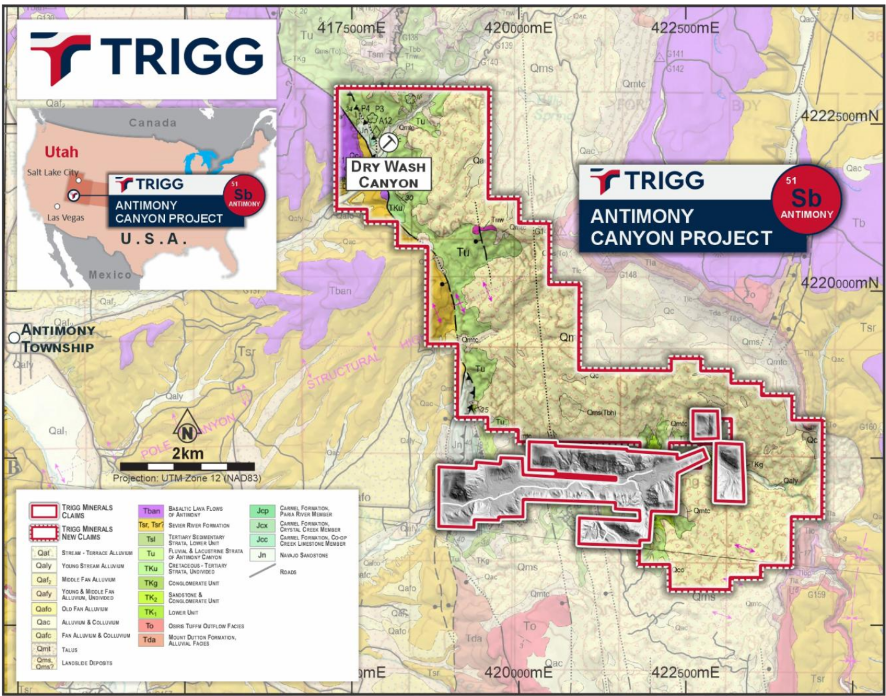
Project location displaying original and extension claim boundaries superimposed on regional geology. The mineralised host unit is depicted in lime green, with additional mineralisation found within the extensive talus slopes beneath the prominent cliffs of Antimony and Dry Wash Canyons
The company has undertaken field reconnaissance and geological mapping, confirming widespread antimony mineralisation beyond the historical resource defined within Antimony Canyon.
The newly identified areas extend up to 10 kilometres north of Antimony Canyon, within the Dry Wash Canyon area. This discovery significantly expands the known mineralised footprint and highlights how underexplored the region remains—particularly when assessed using modern exploration methods.
In response to these encouraging results, Trigg Minerals has moved swiftly to secure the prospective ground. The company has strategically expanded its landholding by staking new claims to the north, extending from Antimony Canyon through to Dry Wash Canyon and beyond. Additional claims have also been staked to the south of Antimony Canyon, further consolidating Trigg’s position in this highly prospective region.
This aggressive expansion ensures that Trigg Minerals maintains control over the interpreted extensions of mineralised structures, reinforcing the potential for a materially larger resource underpinned by modern exploration.
Managing Director, Andre Booyzen, commented: “We are exceptionally pleased with the rapid
direction and response time of our team in capitalising on this opportunity. The confirmation of
antimony mineralisation outside our known resource, particularly at Dry Wash Canyon, and the
emerging understanding of these controlling North-South structures, is a game-changer for the
Antimony Canyon Project. This strategic expansion of our landholding underscores our commitment
to establishing a robust presence in the critical minerals sector and positions Trigg Minerals to
contribute significantly to America’s future antimony production landscape.”